Key takeaways:
- The term GEO comes from a 2023 research paper by Princeton and IIT Delhi researchers, accepted at KDD 2024, which reported visibility gains of up to 40% inside AI answers.
- Google states there are no extra requirements to appear in AI Overviews or AI Mode beyond being indexed and eligible for a snippet.
- SEO is judged on rankings, clicks and traffic; GEO is judged on mentions, citations and share of voice across AI tools.
- ChatGPT search finds sites through OpenAI's OAI-SearchBot crawler, so blocking it can keep you out of those answers.
- Most GEO gains start with ordinary SEO fixes, because an AI tool cannot cite a page it cannot find.
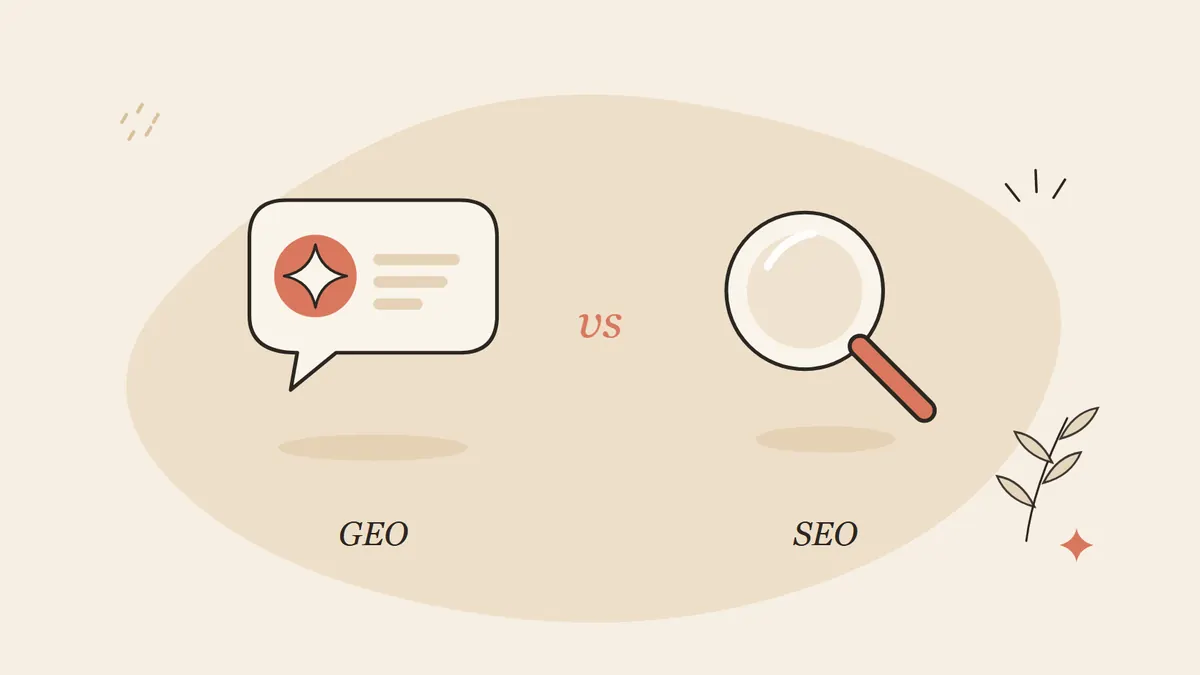
GEO vs SEO is the comparison every marketing budget meeting seems to land on in 2026. The short version: SEO is about where your page shows up in a list of results, and GEO is about whether an AI answer mentions you at all. Same customers, two different places they now get their answers.
The confusion is understandable. Agencies sell GEO as if it were a brand new discipline, while Google insists nothing special is needed. Both statements hold some truth. This guide separates the two, shows where the work overlaps, and gives you a simple order of operations so you spend money on the part that will actually move your numbers. Every claim about how the systems work is linked to the company or researchers who published it.
What is SEO, and what is GEO?
SEO is the practice of making your website easy for search engines to crawl, understand and rank, so it appears high in results and earns the click. GEO is the practice of making your content easy for AI systems to pick up, summarize and credit when they write an answer.
SEO in one paragraph
Search engine optimization has been around since the late 1990s. You fix technical problems so search engines can read your pages, write content that matches what people type, and earn links and reviews that show you are trustworthy. Success looks like page-one positions, more clicks and more leads from organic search.
GEO in one paragraph
Generative engine optimization is younger. The name was coined in a paper titled "GEO: Generative Engine Optimization" by researchers at Princeton University and IIT Delhi, first posted in November 2023 and accepted at the KDD 2024 conference. They tested ways of rewriting content and found GEO methods could boost a source's visibility by up to 40% in AI-generated responses, with results varying by subject area. Success here means the AI names your business, quotes your page or links to you as a source.
A quick naming warning
Some articles use "GEO" to mean geographic or local targeting, as in ranking for "plumber near me." That is local SEO, not generative engine optimization. If a proposal mentions GEO, ask which one the seller means before you compare prices.
GEO vs SEO: what are the main differences?
The core difference is the finish line. SEO wins when a person sees your link and clicks it; GEO wins when an AI model chooses your content as part of the answer it writes, whether or not anyone clicks.
| SEO | GEO | |
|---|---|---|
| Where you appear | A ranked list of links on a results page | Inside a written answer from ChatGPT, Perplexity, Gemini, Copilot or Google AI features |
| What counts as a win | A high position and a click | A mention, a quote or a cited link |
| Who decides | A ranking algorithm comparing pages | A language model choosing which sources to read and credit |
| Main levers | Technical health, keyword-matched pages, backlinks, reviews | Direct answers, facts with named sources, consistent business details, being discussed on other trusted sites |
| How you track it | Search Console, rank trackers, analytics | Repeated prompt testing, AI referral traffic, citation tracking tools |
| Feedback speed | Clicks show up in analytics within days | Many mentions never produce a click, so they stay invisible unless you test for them |
The table makes the two look further apart than they are in practice. Most of the levers on the GEO side also help SEO, and the best signals for both come from the same place: a site that answers questions clearly and is trusted by other sites.
Is GEO the same as SEO?
No, but it is mostly built on the same work. Think of SEO as getting your content into the library and GEO as getting it quoted in the book report. You cannot have the second without the first.
Google says this directly. Its AI features documentation on Google Search Central states there are no additional requirements to appear in AI Overviews or AI Mode and no special optimizations needed. A page only has to be indexed and eligible to show with a snippet. The same page explains that these features may run a "query fan-out," firing off several related searches on subtopics before building one answer. That rewards sites with clear pages on each related question, which is also good SEO.
Outside Google, the picture is similar. OpenAI's crawler overview explains that OAI-SearchBot is the bot that surfaces websites in ChatGPT's search features, while GPTBot is the separate crawler tied to model training. A site that blocks OAI-SearchBot will not appear in ChatGPT search answers. That is a classic SEO-style crawl decision with a GEO consequence.
Does GEO replace SEO?
No. GEO depends on SEO, so it cannot replace it. AI tools that search the web pull from pages they can crawl and rank, which means weak SEO almost always means weak GEO.
What has changed is where the payoff shows up. In Pew Research Center's 2025 browsing study of 900 US adults, about one in five Google searches (18%) produced an AI summary. When that summary appeared, a traditional result was clicked in only 8% of visits, against 15% when no summary appeared, and the links inside the summary itself were clicked in about 1% of visits.
So rankings still matter, but a high position earns fewer clicks on queries that trigger an AI answer. Being one of the sources the AI names is how you stay visible on those searches. That is the case for adding GEO, not for dropping SEO. For more on what actually stopped working, see our take on whether SEO is dead.
Which work helps SEO, which helps GEO, and which helps both?
Most tasks help both channels, a few lean toward one. Sorting your to-do list this way tells you where each hour of effort goes.
| Task | Helps SEO | Helps GEO | Notes |
|---|---|---|---|
| Fix crawl errors, sitemaps and indexing | Strong | Strong | If a page is not indexed, no AI search feature can use it |
| Allow AI search crawlers in robots.txt | Little | Strong | Check OAI-SearchBot, PerplexityBot and Bingbot are not blocked |
| Open each section with a one or two sentence answer | Medium | Strong | Easy for a model to lift whole |
| Add statistics, quotes and named, linked sources | Medium | Strong | These three were the strongest methods in the GEO paper |
| Keep name, address, phone and services identical everywhere | Strong (local) | Strong | Conflicting details make a model less sure who you are |
| Earn reviews and mentions on trusted third-party sites | Strong | Strong | AI tools often cite review sites, directories and articles, not just your site |
| Target specific keywords in titles and headings | Strong | Medium | Still how the underlying search retrieves you |
| Build backlinks through guest posts on relevant sites | Strong | Medium | Links help ranking; mentions in the content help AI answers |
| Add FAQ and article schema | Medium | Medium | Helps machines read the page; Google says no special markup is required for AI features |
| Track rankings and clicks | Strong | Little | Does not show whether AI tools mention you |
| Run a fixed set of prompts monthly and log mentions | Little | Strong | The closest thing GEO has to a rank tracker |
Read top to bottom, the pattern is clear. The technical and trust work sits in both columns, while GEO adds a layer of answer-first writing, sourced facts and off-site reputation. If you want a tactical walkthrough of that layer, our ChatGPT citation playbook covers it step by step, and our guide to schema markup for AI search explains which structured data is worth adding.
How do you measure GEO compared with SEO?
You measure SEO with tools that already exist and are free: Google Search Console for impressions, clicks and positions, and analytics for what visitors do next. GEO has no single dashboard, so you build one from three sources.
What to watch for SEO
- Impressions and clicks per page and query in Search Console. Google notes that traffic from its AI features is counted inside the normal Web search totals, not split out.
- Average position for the queries that bring customers, not vanity terms.
- Leads and calls that started from organic search.
What to watch for GEO
- AI referral visits in your analytics from sources such as chatgpt.com, perplexity.ai, gemini.google.com and copilot.microsoft.com.
- Prompt testing: the same 20 to 30 buyer-style questions asked in several AI tools each month, logging whether you are named and which source gets the credit.
- Share of voice: how often you appear compared with the competitors who show up for the same prompts.
We cover the testing method in detail in our post on AI search citation tracking. Keep the GEO numbers next to your SEO report rather than in a separate silo, because a jump in one often explains a change in the other.
What does the overlap look like in a real result?
Here is a case from our own work that shows the shared foundation. A nationwide business services company had a well-built site, yet its traffic was down 30% and nobody could see why. The cause was the sitemap: the server kept handing Google a frozen copy from December listing 32 pages instead of 53, so three of the four main pages had never been crawled.
The fixes were plain SEO. We repaired the sitemap, consolidated the site onto one web address, redirected 50 old URLs and made the FAQ content readable to AI tools. Comparing the 28 days before with the most recent 28 days on the main address, clicks rose from 36 to 758, average position improved from 12.6 to 6.3, and visits from ChatGPT went from 37 to 115.
Nothing in that project was a GEO trick. The AI visits grew because the pages finally existed in the index that AI search draws from. That is why we treat GEO as the second floor of a building whose ground floor is SEO.
Should a small business focus on GEO or SEO?
Do both, in order: fix the SEO foundation first, then add the GEO layer on top. Splitting them into rival budgets is usually the mistake, because the same pages and the same reputation feed both.
A sensible sequence for most small businesses:
- Get found: confirm your important pages are indexed, your sitemap is current and AI search crawlers are allowed.
- Get clear: rewrite service pages and posts so each section answers one question in its first two sentences.
- Get credible: add facts with named sources, keep business details identical across listings, and ask happy customers for reviews.
- Get mentioned: earn coverage through guest posts on relevant, reputable sites and listings in the directories your industry uses.
- Get measured: report rankings, clicks, AI referrals and prompt-test results together every month.
If you want to know what each piece costs before you commit, our breakdown of AI SEO, AEO and GEO pricing lays out typical market ranges. When you would rather hand it off, our AI SEO services cover both layers under one plan.
Frequently Asked Questions
Is GEO and SEO the same thing?
No. SEO aims to rank your pages so people click them, and GEO aims to get your business named or cited inside AI-written answers. They rely on the same foundation of crawlable, trustworthy content, which is why the work overlaps heavily.
Does GEO replace SEO?
No. AI search features pull from pages that are crawled and indexed, so GEO depends on SEO being in place. Google says its AI Overviews and AI Mode need no special optimization beyond normal indexing and snippet eligibility.
What does GEO stand for in marketing?
In AI search, GEO stands for generative engine optimization, a term from a 2023 Princeton and IIT Delhi research paper. Some marketers also use GEO to mean geographic or local targeting, so ask which meaning a vendor intends.
Can I do GEO without doing SEO?
Not effectively. If your pages are blocked, unindexed or poorly ranked, AI tools that search the web are unlikely to find and cite them. You can work on off-site mentions and reviews, but your own site still needs the SEO basics.
How long does GEO take to show results?
It depends on how strong your SEO already is. On a site that is already indexed and trusted, rewritten pages can start appearing in AI answers within weeks of being recrawled. On a site with technical problems, the SEO fixes come first and set the pace.
Does blocking AI crawlers hurt GEO?
It can. OpenAI says sites that block OAI-SearchBot will not be shown in ChatGPT search answers, while blocking GPTBot only opts you out of model training. Review your robots.txt so you are not shutting out the search crawlers by accident.
Get a free AI SEO audit covering both channels
Not sure whether your gap is in SEO, GEO or both? Ask us for a free AI SEO audit. We check whether your key pages are indexed, whether AI crawlers can reach them, and how often tools like ChatGPT and Google's AI features name you for the questions your buyers ask. You keep the findings either way.
To get started, WhatsApp our team, email info@speedxmarketing.com, or use our contact page. The team at SpeedX Marketing will come back with a clear, fixed-scope next step.