Key takeaways:
- SEO aims for a ranking and a click; AEO aims for your words, facts or brand name inside the answer.
- Google's May 2026 guide on generative AI search says optimizing for it is "still SEO," with no separate AI index.
- In Pew Research's 2025 study, 60% of Google searches starting with "who," "what," "when" or "why" showed an AI summary.
- AEO adds answer-first writing, question coverage and crawler access on top of SEO; it does not replace any of it.
- Several popular AEO tactics, such as llms.txt files and chopping pages into chunks, do nothing for Google Search.
AEO vs SEO is the question behind a lot of confused sales calls right now. One agency tells you SEO is finished and you need AEO instead. Another says AEO is just SEO with a new label. Both are half right, and the half they leave out is the part that decides where your money goes.
This guide gives you the clear version. You will see what each term means, where the two are the same job, what AEO genuinely adds, and which AEO tactics are a waste of time according to the search engines themselves. We finish with a simple way to decide what to fix first, plus two real results from businesses that did both. Every claim about Google or OpenAI links to their own documentation.
What is the difference between AEO and SEO?
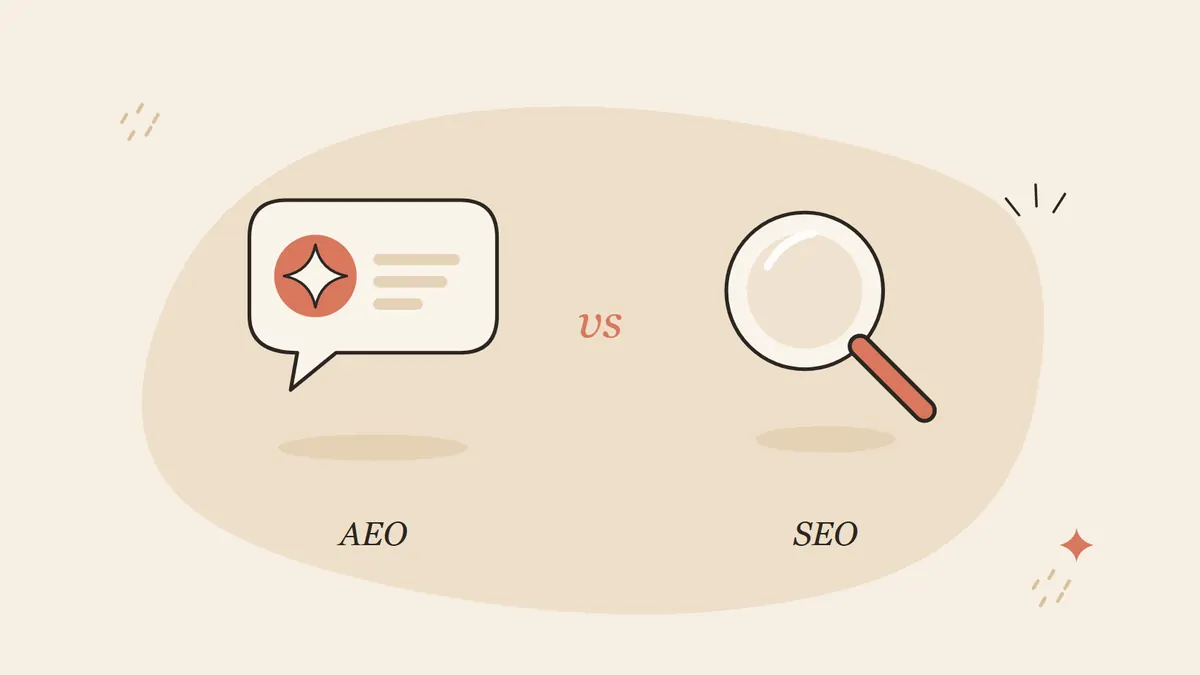
SEO (search engine optimization) is the work of getting your pages ranked high in search results so people choose your link. AEO (answer engine optimization) is the work of getting your content chosen as the answer that a search engine or AI assistant gives directly, often before anyone clicks a link.
Think of the results page as a shop window. SEO is about getting your product onto a good shelf. AEO is about getting the shop assistant to recommend your product by name when a customer asks a question at the counter.
The two in one table
| SEO | AEO | |
|---|---|---|
| The goal | Rank a page so people click it | Be the answer, quote or named source |
| What wins | A position on the results page | A citation, a quoted passage or a brand mention |
| Where it shows | Google and Bing results lists, Maps | AI Overviews, AI Mode, featured snippets, ChatGPT, Perplexity, Gemini, voice assistants |
| Unit of work | A page targeting a search | A question and its clearest answer |
| How the reader acts | Clicks through and reads | Reads the answer, then clicks, calls or remembers your name |
| Main measures | Rankings, impressions, clicks, leads | AI answer appearances, citations, mentions, AI referral visits |
| What it rests on | Crawlable, useful, trusted pages | The same pages, written so the answer is easy to lift |
The last row is the one most comparisons skip. AEO does not have its own foundation. It sits on top of SEO, and if the SEO underneath is broken, the AEO layer has nothing to stand on.
Where the term AEO came from
AEO is older than ChatGPT. The idea grew up around featured snippets (the boxed answer at the top of some Google results) and voice assistants that read out a single answer. Generative AI made the term popular again, because now almost any question can get a written answer instead of a list of links.
Is AEO the same as SEO?
Mostly, yes, and Google now says so in writing. In May 2026, Google published a guide to optimizing for generative AI features on Google Search that names AEO and GEO directly and states that optimizing for generative AI search "is optimizing for the search experience, and thus still SEO."
The same guide explains why. Google's AI Overviews and AI Mode are rooted in its core ranking and quality systems. When the AI writes an answer, it runs a set of related searches in the background (Google calls this "query fan-out") and builds the answer from pages those searches return. If your page would not rank for any of those searches, the AI has no reason to pick it.
So why does AEO get its own name?
Because the finish line moved. A page can rank fifth and still be quoted in the AI answer above all five results. A page can also rank first and be ignored by the answer because the useful sentence is buried under a long story. The ranking work is shared; the "be the easiest answer to lift" work is the extra layer.
There is also the world outside Google. ChatGPT, Perplexity and other assistants run their own searches, crawl with their own bots and choose their own sources. Good SEO still does most of the heavy lifting there, but a few settings, like which crawlers your site allows, only matter for answer engines.
Does AEO replace SEO?
No. Without rankings, crawling and trust, there is nothing for an answer engine to cite. What changes is how you judge success: a month with flat clicks but rising AI answer appearances can be a good month, not a failing one. If you want the wider picture of what AI did to search, our guide on whether SEO is dead walks through the click data.
Where do AEO and SEO overlap?
They overlap on everything that decides whether a search system can find, read and trust your page. If you only have budget for one thing, this shared layer is where it should go, because it pays twice.
- Crawlable and indexed pages. Google's guide says pages must meet its normal technical requirements to show in AI features. A page Google cannot crawl is invisible to rankings and to AI answers alike.
- One clear address per page. Duplicate versions of the same page split signals and confuse both systems about which copy to quote.
- Useful, original content. Google asks for "non-commodity" content with its own point of view. Rewording what ten other sites already say helps neither rankings nor citations.
- Trust signals. Real reviews, accurate business details, named authors and other reputable sites mentioning you all feed both.
- Fast, readable pages. Text that only appears after heavy scripts run, or sits inside images, is easy for a person to see and hard for a crawler to read.
- Business Profile and product data. Google's guide says Business Profiles and Merchant Center feeds can help your products and services show in both AI responses and regular results.
Notice that nothing on this list is labelled AEO or SEO. It is just the work of having a website search systems can rely on. That is why most of an honest AEO program, at least at the start, looks like a careful technical and content SEO audit.
What does AEO add on top of SEO?
AEO adds a layer of formatting, coverage and access choices aimed at one moment: when a system is scanning your page for the single best sentence to answer a question. None of it is exotic, but much of it gets skipped on sites built only to rank.
Answer the question in the first lines
Put the direct answer at the top of the page or section, in one or two plain sentences, then explain. A section titled "How long does a roof replacement take?" should open with a number of days, not a paragraph about your company history. This is the single habit that most separates answer-ready pages from ranking-only pages.
Questions get answers, not lists
The searches that trigger AI answers are the ones phrased like questions. Pew Research Center's 2025 study of 900 US adults' real Google searches found that 60% of searches beginning with "who," "what," "when" or "why" produced an AI summary. Only 8% of one- or two-word searches did, against 53% of searches ten words or longer.
So AEO means covering the long, specific questions your customers actually ask, not only the short phrases SEO tools report. Your sales calls, emails and review replies are the best list of those questions you will ever get.
Cover the follow-up questions too
Because AI answers come from several background searches, a page that covers the main question and its natural follow-ups gives the system more reasons to use it. A page on "water heater replacement" that also answers cost, timing, tank versus tankless, and warning signs gets pulled into more of those background searches than a page that answers one thing.
FAQs written for people, not for robots
A short frequently asked questions section, with real questions and two or three sentence answers, is easy for answer engines to quote. It only works if the questions are real and the answers are specific. Twenty filler questions with vague answers add length and nothing else.
Keep your business facts identical everywhere
Answer engines pull your hours, services, location, prices and reviews from many places at once. When your website says one thing, your Google Business Profile another and a directory a third, the assistant either picks the wrong one or leaves you out. AEO puts more weight on this consistency than classic SEO ever did.
Let answer engines read your site
Some AI tools use their own crawlers, and blocking them can quietly remove you from their answers. OpenAI's crawler documentation states that sites which opt out of OAI-SearchBot will not be shown in ChatGPT search answers, apart from navigational links. It treats GPTBot, the crawler for model training, as a separate setting. You can block training and still allow search, and it is worth checking that your security plugin or firewall has not blocked both by default.
Use structured data where it is earned
Schema markup (code that labels your business details, products, reviews and FAQs for machines) still helps search engines understand a page and is required for many rich results. Google's 2026 guide is clear that it is not required for generative AI search, so treat it as good SEO hygiene, not as an AEO switch. Our guide to schema markup for AI search covers which types are worth adding.
Which AEO tactics can you skip?
Skip anything sold as a special trick for AI that Google's own guide says it does not use. The mythbusting section of Google's 2026 guide lists several of the most common upsells.
| Tactic you may be sold | What Google says | What to do instead |
|---|---|---|
| An llms.txt file or other "AI-only" markup | Google Search does not use these files; adding one will not help or hurt | Make sure your normal pages are crawlable |
| Chopping pages into small "chunks" for AI | Not needed; its systems can find the relevant part of a longer page | Use clear headings and answer-first sections |
| Rewriting pages in many versions for AI | Not needed; AI systems understand synonyms and meaning | Write one strong page per topic |
| Buying or faking brand mentions | Less helpful than it seems; ranking systems favor quality and block spam | Earn mentions from relevant, reputable sites |
| Piling on extra schema just for AI | Not required for generative AI search | Add accurate schema where rich results apply |
One more myth is worth knowing. Google's featured snippets documentation answers the question "can I mark up my page to be a featured snippet?" with a flat "You can't." Google's systems decide. Anyone promising guaranteed answer boxes or guaranteed AI Overview placement is promising something no one controls.
A caution on scope: these points come from Google about Google Search. Other assistants have their own rules, and some tools do read llms.txt files. The money question is whether a tactic has evidence behind it for the assistants your customers actually use, not whether it sounds new.
How do you measure AEO vs SEO?
SEO is measured by rankings, impressions, clicks and the leads those clicks produce. AEO is measured by how often you appear inside answers and how much traffic AI tools send you, which takes a few different reports.
| What you want to know | SEO measure | AEO measure | Where to look |
|---|---|---|---|
| Are people seeing you? | Impressions and average position | AI answer appearances for your pages | Google Search Console |
| Are people coming to you? | Clicks from search | Visits referred by chatgpt.com, perplexity.ai, gemini.google.com and similar | Google Analytics 4, referral traffic |
| Are you named in answers? | Not applicable | Your brand mentioned or cited for your key questions | Manual checks in ChatGPT, Perplexity and Google, or a tracking tool |
| Is it bringing business? | Calls, forms and bookings from organic search | Calls, forms and bookings from AI referrals | GA4 key events, call tracking |
The trap is judging AEO only by clicks. Pew's study found people clicked a regular result on 8% of Google visits that showed an AI summary, against 15% when there was none. Some of your AEO wins will show up as people who already know your name when they call, not as a spike in visits.
For a practical tracking routine, our guide on AI search citation tracking shows how to check what ChatGPT says about you each month. Whoever does the work, your monthly report should carry the SEO and AEO columns side by side, so one never hides the other.
Should a small business focus on AEO or SEO?
Start with whatever is broken in the shared foundation, then add the AEO layer. For most small businesses that means a technical and content audit first, because AEO formatting on a page Google cannot crawl or trust does nothing. Your situation decides the order.
| Your situation | Focus first | Why |
|---|---|---|
| New site, few pages, little traffic | SEO basics | Answer engines need indexed, trusted pages to cite before any formatting matters |
| Site ranks on page one but traffic is falling | AEO layer | Your pages are trusted; they may not be the easiest answer to lift |
| Traffic dropped sharply for no clear reason | Technical SEO audit | Broken redirects, sitemaps or indexing hurt rankings and AI answers together |
| Customers ask long, specific questions before buying | AEO content | Those are the searches most likely to show an AI answer |
| You rely on calls from Google Maps | Google Business Profile and reviews | Google says Business Profiles feed both AI responses and local results |
| ChatGPT never mentions you, Google does | Crawler access and brand mentions | Check OAI-SearchBot is allowed, then earn mentions on reputable sites |
What you should not do
Do not split one small budget into two separate "SEO" and "AEO" retainers with two providers. The work overlaps so heavily that you will pay twice for the same audit. Ask for one plan that covers both, with AEO measures in the monthly report. If you are comparing providers, our guide on what an AI SEO agency is and how to pick one lists the questions to ask.
What happens when you do both?
When the foundation is fixed and the content is answer-ready, AI appearances tend to rise alongside rankings rather than instead of them. Two anonymous results from our own work show the pattern, using the same 28-day window before the fixes against the latest 28 days.
A luxury landscaping company
Google impressions had fallen 76% in three months. The cause was technical: 487 helpful guide articles had been redirected to sales pages, so Google treated them as gone. We rebuilt 589 redirects, recovered 45 lost guides, removed a review rating that did not match real reviews, and added 224 FAQs written as direct answers.
Google AI answer appearances went from 740 to 3,801. Impressions doubled and average position moved from 22.9 to 9.8. The FAQs helped, but they only counted because the guides were back in Google's index first.
A nationwide services company
Traffic was down 30% and the cause was a sitemap that handed Google a frozen list of 32 pages instead of 53. Three of the four main pages had never been crawled. We fixed the sitemap, settled Google on one web address, redirected 50 old URLs and made the FAQs readable to AI tools.
On the main address, clicks went from 36 to 758 and average position from 12.6 to 6.3. Visits from ChatGPT went from 37 to 115. None of that needed an AI-only trick. It needed pages that both systems could reach, plus answers that were easy to quote.
If you want this kind of work done for you, see our AI SEO services, which cover the shared foundation and the AEO layer in one plan.
Frequently Asked Questions
Is AEO replacing SEO?
No. Answer engines build their answers from pages that already rank and are trusted, so SEO is the entry ticket for AEO. What is changing is how success is measured, since being quoted in an answer can matter as much as a click.
What is the difference between AEO and GEO?
The two terms overlap heavily. AEO usually refers to getting your content chosen as a direct answer (snippets, voice, AI Overviews), while GEO (generative engine optimization) usually refers to being cited or mentioned in AI-written answers from tools like ChatGPT. Google's 2026 guide treats both as part of SEO.
How long does AEO take to show results?
It depends on how quickly search systems recrawl your fixed pages and how strong your foundation already is. In the two cases above, the changes were clear when comparing a 28-day window before the fixes with the most recent 28 days. Sites with deep technical problems usually need those fixed before any AEO gains appear.
Do I need an llms.txt file for AEO?
Not for Google. Google's 2026 guide says its search does not use llms.txt files, so adding one neither helps nor hurts there. It is cheap to add, but it should never be sold as the main part of an AEO plan.
Can my current SEO provider do AEO?
Usually, if they understand the extra layer: answer-first writing, question research, crawler settings for AI tools and AEO measures in your reports. Ask them how they track AI answer appearances and ChatGPT referrals. If they cannot show you either, the AEO part is probably a label, not a service.
Does AEO cost more than SEO?
Done properly, AEO adds work to an SEO plan rather than creating a second plan, so it should not double your bill. Market prices vary widely; our breakdown of what AI SEO, AEO and GEO services cost shows the 2026 ranges and what each level buys.
Get a free AI SEO audit
Not sure whether your site needs SEO fixes, an AEO layer or both? Start with a free AI SEO audit. We check whether Google and AI tools can crawl your key pages, which of your customers' questions you already answer, where AI answers mention competitors instead of you, and which fixes would move first. You get a plain-language list of findings and a fixed-scope quote, with no obligation.
WhatsApp our team, email info@speedxmarketing.com, or use our contact page. We are SpeedX Marketing.