Key takeaways:
- AEO aims to have your passage quoted or cited inside an answer, not just to rank a page in a list of results.
- Google says there are no extra requirements or special tricks to appear in AI Overviews or AI Mode beyond being indexed and eligible for a snippet.
- Pew Research Center found people clicked a regular result on 8% of Google visits that showed an AI summary, versus 15% without one.
- The core moves are plain: answer the question in the first lines, use question headings, keep facts specific and sourced, and let AI crawlers in.
- You can check AEO with free tools: ask the AI tools your customers' questions and watch AI referral visits in your analytics.
So what is answer engine optimization, and is it something your business needs to think about? Answer engine optimization is the practice of making your content the source an AI tool or search feature quotes when someone asks a question. It's the reason some businesses get named in ChatGPT's reply while their competitors don't.
The idea isn't brand new. Featured snippets and voice assistants have read single answers off web pages for years. What changed is scale: AI answers now sit at the top of Google and inside chat apps people use every day.
This guide stays on the definition. It covers what counts as an answer engine, how those engines pick a source, how AEO differs from SEO and GEO, examples of AEO on real pages, and how to tell if it's working. If you already know the basics and want the step-by-step version, our 2026 playbook for getting cited in ChatGPT goes deeper.
What is answer engine optimization?
Answer engine optimization is the work of making a page easy for an answer engine to find, trust and lift a passage from. The unit you're optimizing shifts from "the page" to "the paragraph that answers the question."
Traditional SEO asks, "Can this page rank in the top ten links?" AEO asks a narrower question: "If an AI tool reads this page, is there a clear, accurate, self-contained answer it can quote, and a reason to trust it?" A page can rank well and still lose the answer, because its real point is buried under three paragraphs of warm-up.
Why it's called an "answer engine"
A search engine returns options. An answer engine returns a reply. When you ask a smart speaker for a store's closing time, you get one sentence, not ten blue links. When you ask ChatGPT which accounting software suits a five-person company, you get a written recommendation with a few sources attached. AEO is about being the material that reply is built from.
What counts as an answer engine?
Any search feature or AI tool that writes or reads out an answer instead of only listing links counts as an answer engine. In 2026, the ones that matter for most US small businesses are below, along with where each one gets its material.
| Answer engine | What the user sees | Where the answer comes from |
|---|---|---|
| Google featured snippet | A boxed excerpt above the regular results | A passage from a page in Google's index, picked automatically |
| Google AI Overviews | An AI summary at the top of results, with source links | Google's index; the page must be eligible to show a snippet |
| Google AI Mode | A chat-style AI answer inside Google Search | Google's index, searched across several related sub-questions |
| ChatGPT search | A written reply with cited sources | Pages OpenAI's search crawler (OAI-SearchBot) is allowed to reach |
| Perplexity | A written reply with numbered citations | Live web search at the moment of the question |
| Microsoft Copilot | A chat answer with source links | Bing's web index |
| Gemini | A chat answer, sometimes with links | Google Search and the model's own training |
| Voice assistants | One spoken answer | Usually a single top result or snippet |
The table shows something useful: almost every answer engine still depends on a search index. If your page isn't crawled and indexed, no amount of clever formatting will get it quoted.
How does answer engine optimization work?
AEO works by matching how answer engines build a reply: they search, collect a handful of candidate pages, judge which passages answer the question best, and write a response that cites the winners. Each step is a place where your page can drop out or move ahead.
Step 1: The engine has to be able to reach your page
Google is direct about this. Its Search Central guide to AI features says a page must be "indexed and eligible to be shown in Google Search with a snippet" to appear as a supporting link in AI Overviews or AI Mode. If your page carries a nosnippet rule, or never got indexed, it's out before the race starts.
ChatGPT works the same way through its own crawler. OpenAI's crawler documentation says OAI-SearchBot is what surfaces websites in ChatGPT's search features, and it recommends allowing that bot in your robots.txt file. Sites that block it won't be shown in ChatGPT search answers. That's a one-line setting many businesses have never checked.
Step 2: The engine breaks the question apart
AI answers rarely run one search. Google describes a "query fan-out" technique in the same Search Central guide: the system issues several related searches across subtopics to build one response. A question like "is a heat pump worth it in a cold climate" may trigger hidden searches about cost, efficiency below freezing, and rebates.
For you, that means a page which answers the main question and its obvious follow-ups has more chances to be picked. Thin pages that answer one narrow angle get fewer shots.
Step 3: The engine judges passages, not just pages
Once it has candidate pages, the engine looks for the passage that answers cleanly. Pages that put the answer in the first one or two sentences under a heading, use plain terms, and back claims with specific numbers and named sources are easier to lift. A paragraph that only makes sense after reading the three before it is hard to quote.
Step 4: The engine writes the reply and cites sources
Finally, the engine combines what it found into one answer and links some of the pages it used. Being cited is the AEO win. Being mentioned by name, even without a link, also counts, because the reader still hears your brand at the moment they're deciding.
Research supports the idea that content choices change who gets cited. The 2023 paper GEO: Generative Engine Optimization by researchers including Pranjal Aggarwal and Karthik Narasimhan, accepted at KDD 2024, reported that content changes could lift a source's visibility in generative engine responses by up to 40%, with results varying by topic.
How is AEO different from SEO?
AEO is a layer on top of SEO, not a replacement for it. SEO earns you a place in the index and a strong ranking; AEO makes the content on that page the easiest answer to quote.
| Traditional SEO | Answer engine optimization | |
|---|---|---|
| Goal | Rank a page high in a list of links | Be the passage an engine quotes or cites |
| Unit of work | The whole page and its keywords | The paragraph that answers one question |
| Typical query | Short phrases ("plumber denver") | Full questions ("why is my water heater leaking from the top?") |
| Win looks like | A click from position 1 to 10 | Your name or link inside the answer |
| Key metrics | Rankings, clicks, organic visits | Citations, brand mentions, AI referral visits |
| Still needs | Crawlable, fast, indexed pages | All of the SEO list, first |
Google's own line settles the "do I need special tricks" question. The Search Central guide states: "There are no additional requirements to appear in AI Overviews or AI Mode, nor other special optimizations necessary." In other words, AEO for Google is good SEO plus content written so the answer is easy to find.
Google also confirms you can't tag your way into a featured snippet. Its featured snippets documentation says Google's systems decide automatically whether a page makes a good snippet, and there is no markup to request one. That's why AEO is mostly about writing and site health, not code tricks.
Is AEO the same as GEO or AI SEO?
In practice, mostly yes. AEO, generative engine optimization (GEO) and AI SEO describe heavily overlapping work, and different agencies use different labels for the same service.
There is a small difference in emphasis. AEO grew out of featured snippets and voice search, so it focuses on direct answers to direct questions. GEO comes from the 2023 research paper above and focuses on being cited inside AI-written responses. AI SEO is the umbrella term most buyers search for. If you're comparing providers, our guide to what an AI SEO agency is explains why the label matters less than the work behind it.
What does AEO look like in practice?
AEO in practice is usually small, specific edits to pages you already have, plus a few new pages built around the questions customers actually ask. The examples below show the kind of change that makes a passage quotable.
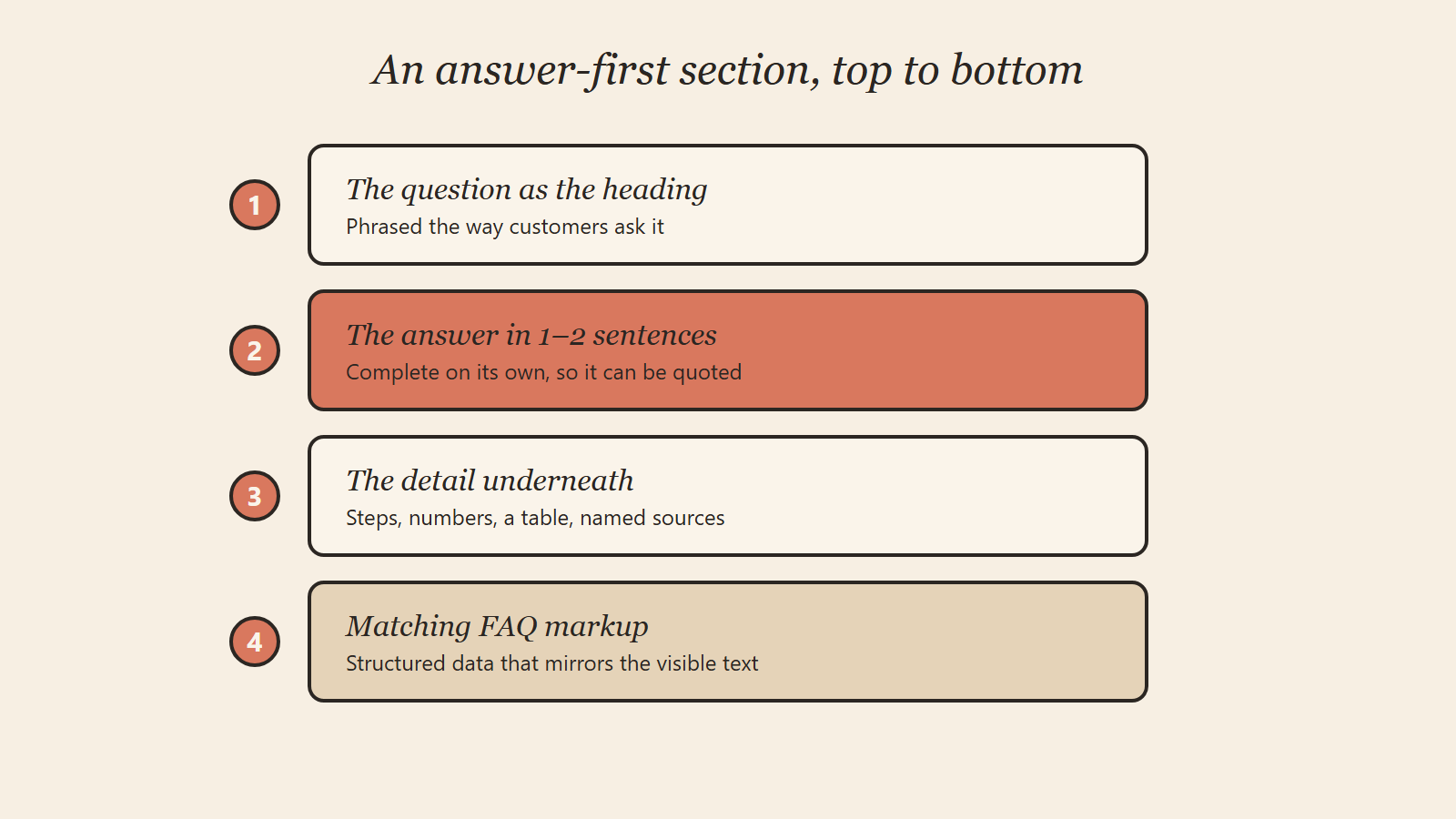
Example 1: Moving the answer to the top
A dental practice's page on implant cost opened like this:
"At our practice, we believe every smile deserves care. Dental implants are a popular option that many patients consider when exploring ways to restore their teeth..."
After an AEO rewrite, the same section opens:
"Most single dental implants cost between [range from your own fee schedule], including the post, abutment and crown. Your total depends on whether you need a bone graft and how many teeth are being replaced."
The second version answers "how much does a dental implant cost" in its first sentence. An answer engine can quote it whole. The first version makes it dig.
Example 2: Turning a heading into the real question
A heading that reads "Our Process" gives an engine nothing to match. "How long does a kitchen remodel take?" matches a question people type and speak word for word. The fix takes seconds, and the content under it should open with the answer ("Most of our kitchen remodels take [your typical range] from demolition to final inspection") before the detail.
Example 3: Making facts checkable
"We're one of the most trusted roofers around" can't be verified, so an engine has little reason to repeat it. "Licensed in [state] since [year], with [number] Google reviews averaging [rating]" can be checked against other sources. Specific, consistent facts that match your Google Business Profile and directory listings are what engines trust enough to state.
Example 4: Structured data that matches the page
Schema markup labels what's on a page: a business, an FAQ, an article, a product. It doesn't force a citation, but it removes guesswork when the labels match the visible text. Our guide to schema markup for AI search covers which types are worth adding.
What these changes did on real sites
Here are two anonymous results from our own client work, comparing the 28 days before our changes went live with a recent 28 days, using Search Console's AI answer data:
- A luxury landscaping company: appearances in Google AI answers went from 740 to 3,801 after we fixed broken redirects, recovered lost guide articles and added 224 FAQs.
- A solar installer: appearances in Google AI answers went from 783 to 3,602 after we set the site up for AI search and repaired a blog that a rebuild had hidden from Google.
Neither result came from a trick. Both came from fixing what stopped engines from reaching good content, then making that content easier to quote.
Why does AEO matter for a small business?
AEO matters because fewer people click through to websites when an AI answer appears, so the businesses named inside that answer get a growing share of attention. If you're not in the answer, you can rank and still be skipped.
The clearest data comes from Pew Research Center's July 2025 study. It tracked 68,879 Google searches by 900 US adults in March 2025. Users clicked a traditional result on 8% of visits that showed an AI summary, compared with 15% of visits without one. Only 1% of visits included a click on a link inside the summary itself.
That last number cuts both ways. Clicks from AI answers are scarce, but the reader still sees which brands the answer names. For a local service business or a niche B2B firm, being the plumber, accountant or software vendor an answer recommends can matter more than a click.
Who should care most
AEO pays off fastest for businesses whose customers ask questions before they buy:
- Service businesses where people ask "how much," "how long" and "do I need" questions.
- Professional firms (law, accounting, healthcare) where trust and clear explanations decide the hire.
- Ecommerce stores selling products that need comparison or explanation.
- B2B companies whose buyers research with ChatGPT before talking to sales.
If your customers only search your brand name to find your phone number, AEO is lower priority than getting your Google Business Profile right.
What AEO is not
A lot of AEO pitches promise things no one can deliver. Knowing what AEO isn't will help you spot a weak offer.
- It's not a guarantee. No one controls what ChatGPT or Google writes. An agency promising "guaranteed AI citations" is promising something outside its control.
- It's not a paid placement. There's no way to pay Google or OpenAI to appear inside organic AI answers. Ads are separate and labeled.
- It's not a separate website. You don't need an "AI version" of your site. The same pages serve people and engines.
- It's not just schema. Markup helps engines read a page, but it can't make a vague page worth quoting.
- It's not keyword stuffing for chatbots. Repeating phrases makes a passage worse to quote, not better. Clear writing wins.
- It's not a one-time task. Answers change as engines update and competitors publish. Pages need checking and refreshing.
If a proposal leans on any of these, ask what will actually change on your pages and how you'll see the result. Our breakdown of what AI SEO, AEO and GEO services cost lists the line items a fair scope should include.
How do you know if AEO is working?
You know AEO is working when your business starts appearing in AI answers for the questions you care about, and when visits from AI tools start showing up in your analytics. Both can be checked for free.
Free checks you can run this week
- Write down 10 to 20 real customer questions. Use wording from calls, emails and reviews, not keywords.
- Ask them in ChatGPT, Perplexity, Gemini and Google. Note whether your business is named, linked, or missing, and who appears instead.
- Look at Search Console. Google says sites shown in AI features are counted in the overall search traffic in Search Console's Performance report, so impressions and clicks from AI Overviews show up there.
- Look at referrals in Google Analytics 4. Visits from chatgpt.com, perplexity.ai, gemini.google.com and copilot.microsoft.com show which AI tools are sending people.
- Repeat monthly. AI answers shift, so one snapshot means little. A monthly check shows the trend.
Our article on AI search citation tracking walks through a fuller version of this method, including how to log results so you can compare month to month.
Frequently Asked Questions
What is answer engine optimization in simple terms?
Answer engine optimization means making your web pages the source that AI tools and search features quote when they answer a question. It covers how the page is written, how it's structured, and whether engines can reach it. The goal is to be named inside the answer, not just listed below it.
Is AEO replacing SEO?
No. AEO depends on SEO, because answer engines mostly pull from pages that are already crawled and indexed. Think of SEO as getting into the room and AEO as being the one quoted once you're there.
Does schema markup help with answer engine optimization?
It helps engines understand what a page is about, such as your business details or a set of FAQs, as long as the markup matches what's visible on the page. It doesn't guarantee a citation, and Google says no special markup is needed to appear in AI Overviews or featured snippets. Treat it as support for good content, not a substitute.
How long does AEO take to show results?
Fixes that unblock crawling, such as allowing OAI-SearchBot or removing a stray nosnippet rule, can matter within days to weeks once pages are recrawled. Content changes usually take one to three months to show a clear trend, because engines need to revisit pages and answers vary from day to day. Track it monthly, not daily.
Can I pay to appear in ChatGPT or Google AI answers?
Not in the organic answer. Google and OpenAI choose sources on their own, and any paid placement is shown as an ad. Anyone selling guaranteed placement inside organic AI answers is overpromising.
Do I need an agency for AEO?
Not always. A small business can handle the basics: rewrite key pages answer-first, fix question headings, check robots.txt, and run monthly checks in the AI tools. An agency helps when the site has technical problems, many pages to update, or no time in-house to keep at it.
Get a free AI SEO audit
Before you change anything, it helps to see where you stand. Our free AI SEO audit checks whether Google and AI crawlers can reach your key pages, tests a set of your customers' real questions in ChatGPT, Perplexity and Google, and shows which pages are closest to being quoted. You'll get a short list of fixes in priority order, whether or not you hire us. If you want help after that, our AI SEO services quote a fixed scope based on what the audit finds.
To book it, WhatsApp our team, email info@speedxmarketing.com, or use our contact page. We're SpeedX Marketing.