Key takeaways:
- GEO aims to get your business named and linked inside an AI-written answer, not only listed as a blue link.
- The name was coined by researchers Pranjal Aggarwal and colleagues in a November 2023 arXiv paper, later accepted to the KDD 2024 conference.
- In that study, keyword stuffing made pages less visible, while quotations, statistics and source citations made them more visible.
- Google says there are no special optimizations needed to appear in AI Overviews or AI Mode, so GEO sits on top of normal SEO rather than replacing it.
If you have asked yourself what generative engine optimization is, you are probably seeing the term in agency pitches and wondering whether it describes anything new. Generative engine optimization is real, it is measurable, and it overlaps heavily with good SEO. The difference is the target: instead of a position on a results page, you want a place inside the answer an AI tool writes.
This guide explains GEO without the hype. You will see where the term started, how AI tools assemble an answer, what the original research actually tested, and what GEO work looks like on a small business website. If you want the hands-on version after this, our ChatGPT citation playbook goes step by step.
What is generative engine optimization?
Generative engine optimization is the practice of shaping your web content so AI systems that write answers will pick it as a source, describe it correctly and credit it. Success means your brand, facts or page show up inside the generated reply, ideally with a link.
A "generative engine" is any search tool that writes a reply instead of only listing links. Today that includes ChatGPT with search, Perplexity, Google AI Overviews and AI Mode, Gemini, Microsoft Copilot and Claude with web search. Each one reads several sources, blends them and decides which ones to show.
That changes the job. Classic SEO asks, "Can I rank in the top ten?" GEO asks three narrower questions:
- Will the AI find my page when it searches for this topic?
- Will it lift my wording or facts into the answer it writes?
- Will it name or link me so the reader can tell where the information came from?
A page can rank well and still lose all three. A page that ranks fifth can win all three if it answers more cleanly than the pages above it, which is one of the more useful findings from the research below.
Where did the term GEO come from?
The term comes from a paper titled GEO: Generative Engine Optimization, posted to arXiv on November 16, 2023 by Pranjal Aggarwal, Vishvak Murahari, Tanmay Rajpurohit, Ashwin Kalyan, Karthik Narasimhan and Ameet Deshpande. It was revised in 2024 and accepted to KDD 2024, a major data science conference. Before this paper, people mostly called the topic "AI SEO" or "LLM optimization."
The researchers built a test set they called GEO-bench, made of 10,000 search queries drawn from nine sources. They then took real web pages, rewrote them using nine different methods, and measured how much of each page showed up in AI-generated answers, and how prominently.
What did the GEO research actually test?
Each method changed only the content of a page, not its links or technical setup. The table shows the paper's main visibility score for each method. The page with no changes scored 19.5, so anything higher helped and anything lower hurt.
| Method the researchers tested | What they changed | Visibility score (baseline 19.5) | What it means for you |
|---|---|---|---|
| Quotation addition | Added relevant quotes from credible people or sources | 27.8 | Named, quotable statements get lifted |
| Statistics addition | Swapped vague claims for numbers | 25.9 | Specific figures beat adjectives |
| Fluency optimization | Made the writing read more smoothly | 25.1 | Clean prose is easier to reuse |
| Cite sources | Added citations to credible sources | 24.9 | Showing your sources builds machine trust |
| Technical terms | Added precise terminology | 23.1 | Use the real names of things |
| Easy-to-understand | Simplified the language | 22.2 | Plain wording helps a little |
| Authoritative tone | Made the text sound more confident | 21.8 | Tone alone does little |
| Unique words | Added unusual vocabulary | 20.7 | Fancy wording barely moves anything |
| Keyword stuffing | Repeated words from the query | 17.8 | Old-school stuffing made pages less visible |
The headline result: the best methods raised visibility by up to about 40%. Keyword stuffing was the only method that scored below the untouched page, which is a useful warning for anyone still writing for 2010-era search.
What happened in the live Perplexity test?
The team also ran a smaller check on Perplexity, a real AI search engine, using 200 queries. Adding quotations improved the main visibility score by 22%, adding statistics improved the impression score by 37%, and keyword stuffing made results about 10% worse. The live test pointed the same way as the lab test.
Why does the research matter for smaller sites?
The most hopeful finding was about pages that ranked lower. When a page sat fifth in the search results, adding citations raised its visibility in the AI answer by 115.1%, while the top-ranked page lost 30.3% on average. Quotations (99.7%) and statistics (97.9%) gave similar boosts to fifth-place pages.
In plain terms, AI answers do not simply copy the number one result. A smaller business with a clearer, better-sourced page can earn a mention that its search position alone would not deliver.
What are the limits of the research?
Treat the paper as evidence, not a rulebook. Most of the testing ran on a benchmark rather than across today's live tools, and AI search products have changed a lot since 2023. The paper itself notes that results varied by subject area, so a method that helped history questions might do less for legal or health topics.
How does generative engine optimization work?
GEO works by improving your odds at each step an AI tool takes before it shows an answer. Most AI search tools search the web, pull a shortlist of pages, pick the passages that answer best, write a reply and attach some sources. You can influence every step except the last word.
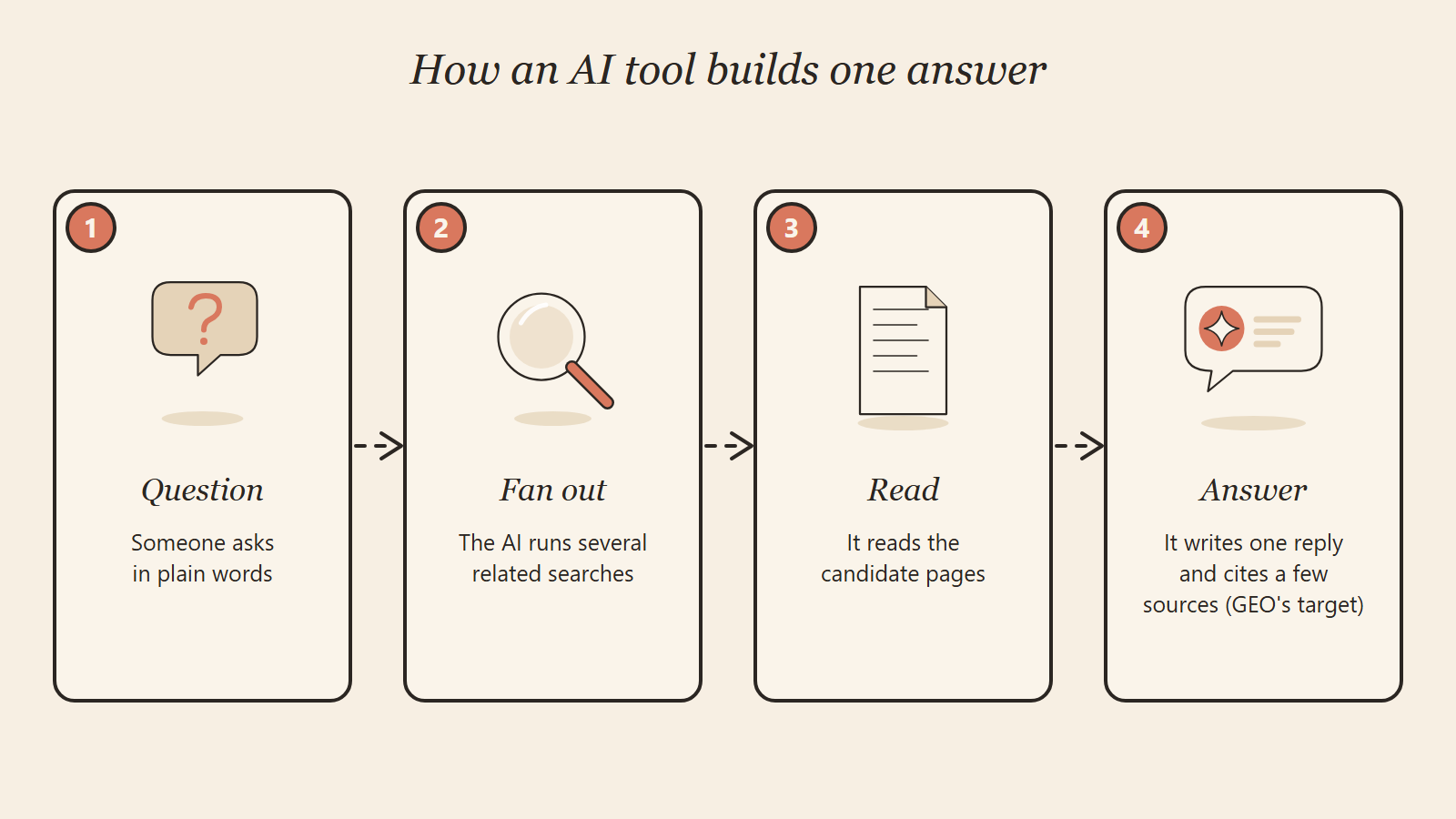
Google describes one part of this openly. Its Search Central guide to AI features says AI Overviews and AI Mode may use a "query fan-out" technique, running several related searches across subtopics to build one response. So a single question about your service can trigger searches on cost, timing, risks and alternatives at the same time.
| Stage | What the AI tool does | What GEO work targets |
|---|---|---|
| 1. Understand the question | Splits the prompt into several smaller searches (fan-out) | Pages that cover the follow-up questions, not just the headline one |
| 2. Retrieve | Pulls candidate pages from a search index | Pages that are crawlable, indexed and rank somewhere for those sub-questions |
| 3. Select passages | Picks the chunks that answer most directly | Answer-first paragraphs, specific numbers, clear headings |
| 4. Write the answer | Blends several sources into one reply | Claims that still make sense when lifted out of context |
| 5. Credit sources | Names or links some of the pages it used | Consistent business facts, cited sources, a brand the AI can identify |
Notice that stages 1 and 2 are ordinary SEO. If your page is blocked, slow to load, not indexed or invisible for the topic, nothing later in the chain can save it. Stages 3 to 5 are where GEO adds something extra.
Why does the AI cite one page and skip another?
It usually comes down to how easy the passage is to use. An AI tool writing a short answer prefers a sentence that states a fact, names its source and stands on its own. A page that buries the answer under a long story, or hides its numbers in an image, gives the tool less to work with.
Brand clarity matters too. If your name, address, services and prices read differently across your site, your Google Business Profile and directory listings, the AI has a harder time deciding which version is true. Clean structured data helps here, and our guide to schema markup for AI search covers which types are worth the effort.
Is generative engine optimization real, or just SEO renamed?
GEO is real in the sense that AI answers can be measured and influenced, and the 2023 study showed content changes move the needle. It is not a separate discipline that replaces SEO. Most of what helps you in AI answers also helps you in regular search.
Google is direct about this. Its AI features guide says, "There are no additional requirements to appear in AI Overviews or AI Mode, nor other special optimizations necessary." The same page says there is no special schema.org markup you need to add.
So where does the "GEO is just SEO" argument go wrong? It misses three things that genuinely change:
- The unit of success is a passage, not a page. You win by having one paragraph the AI can lift whole, even if the rest of the page is long.
- The measurement is different. You track mentions, citations and how accurately AI tools describe you, on top of rankings and clicks.
- Off-site consistency matters more. AI tools blend many sources, so what other sites and listings say about you feeds straight into the answer.
Which GEO claims should you be wary of?
Be careful with anyone who promises guaranteed placement in ChatGPT or AI Overviews. No one controls what these tools say, and their answers change from one run to the next. Be equally wary of "secret prompts," mass-produced AI pages, or a plan that is only schema markup. The research rewards substance, and the clearest data point in the paper is that stuffing keywords made pages worse.
If you are deciding whether search is still worth investing in at all, our piece on whether SEO is dead walks through what changed in 2026 and what did not.
How is GEO different from SEO and AEO?
SEO, AEO and GEO describe overlapping work with different targets. SEO aims for rankings and clicks, answer engine optimization (AEO) aims for direct-answer spots such as featured snippets and voice replies, and GEO aims for citations inside AI-written answers.
| SEO | AEO | GEO | |
|---|---|---|---|
| Main goal | Rank pages in search results | Be the direct answer to a question | Be a source inside an AI-written reply |
| Where you show up | Google and Bing results pages | Featured snippets, People Also Ask, voice assistants | ChatGPT, Perplexity, AI Overviews, AI Mode, Gemini, Copilot |
| What you measure | Rankings, clicks, traffic, leads | Snippet and answer-box wins | Mentions, citations, AI referral visits, answer accuracy |
| Core content move | Relevant, well-linked pages | Short, direct answers to real questions | Quotable facts with sources, consistent brand data |
| Can it work alone? | Yes | Rarely | No, it depends on SEO foundations |
In practice, a small business does not need three separate vendors or three budgets. One well-run program covers all three, because the same page can rank, win a snippet and get cited. Separate guides in this series compare GEO with SEO and with AEO in more depth.
Why does GEO matter for a small business?
GEO matters because AI summaries are taking clicks that used to go to ordinary results, and being cited is how you stay in front of the buyer. If your competitor is named in the answer and you are not, many searchers never scroll far enough to find you.
The clearest independent data comes from Pew Research Center's 2025 study, which tracked the browsing of 900 US adults during March 2025. When a Google AI summary appeared, people clicked a traditional result on 8% of visits, compared with 15% when no summary appeared. They clicked a link inside the summary itself on just 1% of visits.
Two conclusions follow. First, fewer clicks reach the plain results, so ranking alone carries less weight than it did. Second, the few links inside the summary are scarce, which makes being one of them more valuable, and it also means your name in the answer matters even when nobody clicks.
The same Pew study found 18% of the Google searches it recorded showed an AI summary. That share depends on the topic and the month, so check your own figures rather than assuming the average applies to your industry.
What does GEO look like on your own website?
GEO on a real website mostly means rewriting key pages so their answers are short, specific and sourced, then making sure your business facts match everywhere. It is editing work more than technical work, which is good news for small teams.
A before-and-after example
Here is a paragraph a plumbing company might have on its water heater page:
Before: We are the area's trusted experts in water heater installation. Our experienced team provides top-quality service at competitive prices, and we always put our customers first.
An AI tool can do almost nothing with that. It states no fact, answers no question and could describe any plumber in the country. Now compare:
After: A standard 40 to 50 gallon tank water heater install usually takes 2 to 3 hours. Tankless units take longer, often most of a day, because gas lines or venting may need changes. We quote a fixed price after a site visit, and the U.S. Department of Energy's water heater guide is a good place to compare tank and tankless running costs.
The second version answers a real question, gives specific figures, names a credible outside source and states the company's own policy in one sentence. Those are the same moves the 2023 research rewarded. Use real figures from your own jobs; do not copy these.
A starter GEO checklist
- Open each key page with the answer. Put a two to three sentence reply to the page's main question at the top.
- Swap adjectives for facts. Replace "fast" and "affordable" with timeframes, ranges and named policies.
- Cite your sources. Link to official bodies, manufacturers or studies when you state a number you did not create.
- Add a short FAQ using the questions customers actually ask you on the phone.
- Make your business facts match across your site, Google Business Profile and main directory listings.
- Check your robots.txt so you are not blocking the crawlers AI search tools use to read pages.
- Cover the follow-up questions on cost, timing, risks and alternatives, because fan-out searches look for them.
None of this needs special software. It needs someone to read your pages the way an AI tool would and fix what gets in the way.
How do you know if GEO is working?
You know GEO is working when AI tools mention you more often, describe you accurately and send you visits. Track it with free tools first, then decide whether you need a paid tracker.
- Google Search Console. Google says traffic from AI features is counted in the Performance report under the "Web" search type, so watch impressions and clicks on the pages you rewrote.
- Google Analytics 4. Look at referral traffic from sources like chatgpt.com, perplexity.ai, gemini.google.com and copilot.microsoft.com.
- Manual prompt checks. Once a month, ask five to ten AI tools the questions your customers ask and record whether you are named, linked and described correctly.
- Lead quality. Ask new customers how they found you. "ChatGPT recommended you" is now a common answer.
For a fuller method, including a spreadsheet you can copy, see our guide to AI search citation tracking.
What does progress look like in real numbers?
Results take a few months and depend on how broken the site was to begin with. For one landscaping company we worked with, appearances in Google's AI answers went from 740 to 3,801 when we compared the 28 days before our fixes with a recent 28-day window. A solar installer's AI answer appearances went from 783 to 3,602 over a similar comparison. In both cases the gains came from fixing basics first (redirects, crawl problems, inaccurate review data), then adding clear answers and FAQs.
Those are past results, not a promise. They do show the order that tends to work: fix what stops AI tools from reading you, then make your pages worth quoting.
Frequently Asked Questions
Who coined the term generative engine optimization?
The term was introduced by Pranjal Aggarwal and five co-authors in the paper "GEO: Generative Engine Optimization," first posted to arXiv in November 2023. It was later accepted to the KDD 2024 conference, and the name spread quickly through the marketing industry after that.
Does GEO replace SEO?
No. AI search tools pull their sources from search indexes, so a page that is not crawlable or not ranking for anything rarely gets cited. GEO adds a layer on top of SEO: quotable answers, sourced facts and consistent brand data.
Can anyone guarantee my business will be cited by ChatGPT?
No one can honestly guarantee it. AI tools decide their own sources and their answers vary between runs, users and dates. A credible provider will promise specific work and transparent tracking, not placement.
How long does generative engine optimization take to show results?
In our experience, early movement often shows within two to three months once crawl problems are fixed and key pages are rewritten. AI tools need to re-read your pages, and some refresh their sources faster than others. Measure from a baseline so you can see real change, not guesses.
Do I need special schema or a new kind of file for GEO?
Not according to Google, which says no special schema.org markup is needed for its AI features. Standard structured data such as Organization, LocalBusiness and FAQ markup still helps tools understand your business. Spend your effort on clear content first and markup second.
Is generative engine optimization the same as AI SEO?
Mostly, yes. "AI SEO" is the broader everyday label for optimizing for AI search, while GEO is the research term focused on getting cited in AI-written answers. Agencies use the two names almost interchangeably, so ask what work is included rather than which label is on the proposal.
Get a free AI SEO audit and see where you stand
Before you spend anything on GEO, find out how AI tools describe your business today. We will run your key questions through ChatGPT, Perplexity and Google's AI features, check whether your pages are readable to them, and send you a short list of the fixes that matter most. Our AI SEO services page shows what ongoing work covers, and if you are budgeting, our GEO pricing guide lays out market ranges.
To book the free audit, WhatsApp our team, email info@speedxmarketing.com, or use our contact page. We quote a fixed scope after the audit, so you know the cost before any work starts. Talk soon, from the team at SpeedX Marketing.