Schema markup used to be a Google ranking factor with limited consequence — implement Organization, maybe FAQ, maybe Article, and move on. By 2026, structured data has become disproportionately important because AI search engines parse it differently than traditional crawlers do. Done right, schema helps your pages surface in ChatGPT, Claude, Perplexity, and Google AI Overviews with significantly more frequency. Done wrong (or skipped), you're handing extraction wins to competitors. This guide covers what schema actually moves the needle for AI search in 2026, how to implement it cleanly, and the patterns to skip because they're cosmetic at best.
Why schema matters more for AI search than it did for Google ranking
Traditional Google ranking didn't depend heavily on schema. Rankings were driven by content quality, links, technical factors, and Google's NLP understanding of the page itself. Schema helped with rich results — but a page could rank well with no schema at all.
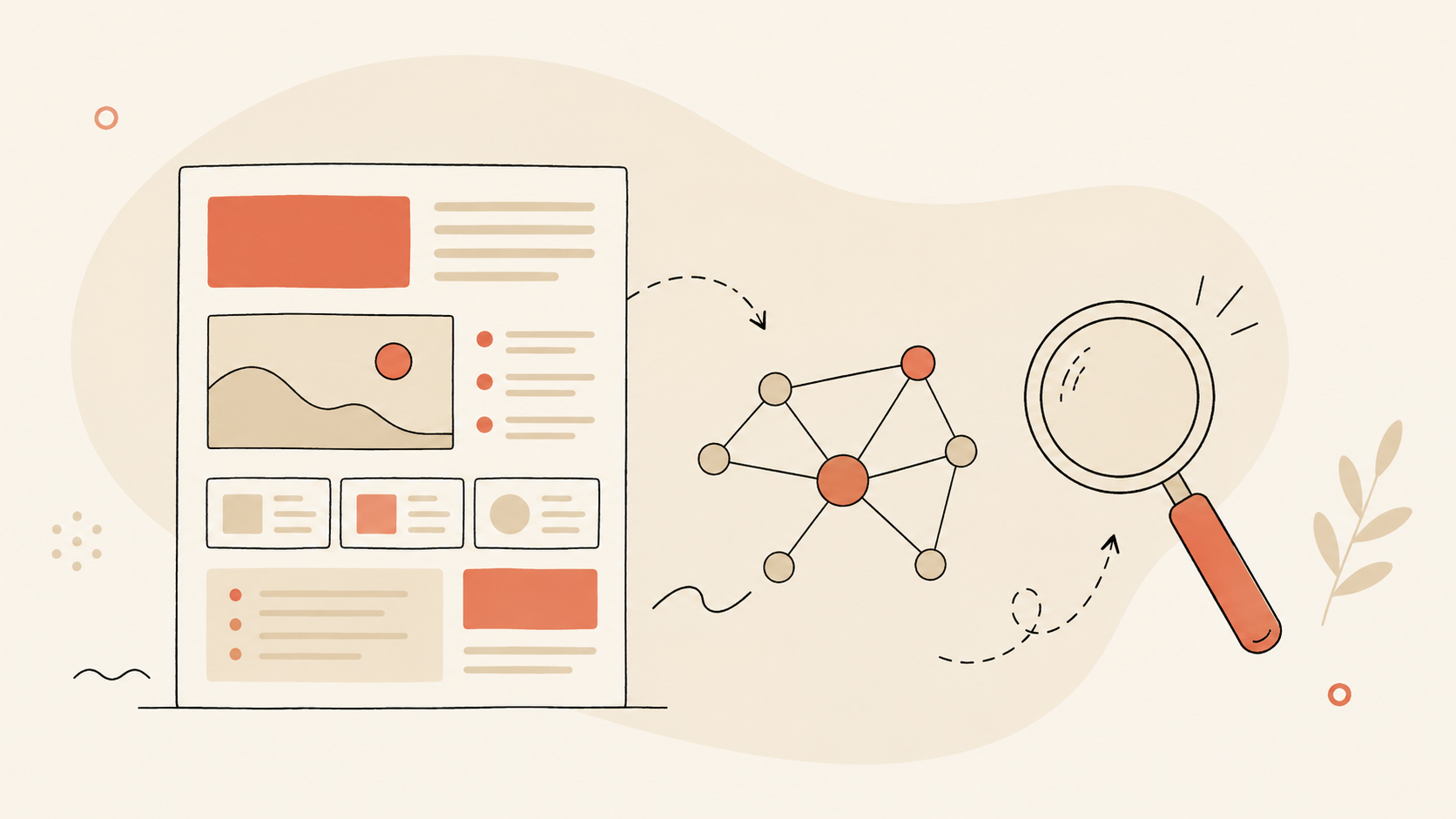
AI search is structurally different. AI summarizers are trying to extract specific entities and relationships from your page to incorporate into an answer. Schema gives them those entities and relationships in machine-readable form. The result: pages with clean, comprehensive schema tend to get extracted more often, cited more reliably, and represented more accurately in AI answers than pages without.
The asymmetry is real. A page with strong content and clean schema outperforms a page with strong content and no schema, even when the rest of the on-page signals are identical.
The schema types that actually matter for AEO in 2026
Skip the urge to implement everything. Focus on these:
Organization / LocalBusiness
Every business needs this. The Organization (or LocalBusiness, for location-specific businesses) schema tells AI engines who you are, where you operate, how to contact you, and what you do.
Key properties to include:
name— your exact brand nameurl— your canonical homepagelogo— absolute URL to a high-resolution versiondescription— 1–3 sentence description matching your homepage messagingsameAs— links to your LinkedIn, X/Twitter, Instagram, Facebook, YouTube, Wikipedia (if applicable)contactPoint— telephone, email, language, hours- For LocalBusiness:
address,geo,openingHoursSpecification,areaServed foundingDate— important for AI engines to understand business maturitynumberOfEmployees— when meaningful and willing to disclose
The sameAs property is particularly valuable for AI search. It helps the AI's underlying knowledge graph connect your site to your social presence, which strengthens entity confidence.
FAQPage
Among the highest-ROI schema types for AEO. FAQ schema tells AI engines exactly what questions a page answers and what the answers are. Both Google AI Overviews and other AI engines reliably extract from well-structured FAQ pages.
Implementation rules:
- Only mark up content actually visible on the page
- Use real questions users ask (not keyword-stuffed pseudo-questions)
- Keep answers substantive and self-contained (2–4 sentences each)
- Include 5–10 questions per page; more is fine, but quality matters
Don't use FAQ schema on every page just to game it. Google has demoted spammy FAQ usage, and AI engines do the same.
Article (with proper author + publisher)
For any blog post or editorial content, Article schema with proper author and publisher markup is essential. Critical fields:
headline— match your H1datePublishedanddateModified— both, accuratelyauthor— full Person schema withname,url, ideallysameAslinking to LinkedIn or other authoritative profilepublisher— Organization schema (matches your site Organization)image— absolute URL, ideally 1200x675 or largerdescription— meta description equivalentwordCount— useful signalarticleBody— the full body text (or a meaningful summary)
The author field matters more than people realize. AI engines increasingly weight pages with real, verifiable authors over anonymous content. If you have subject-matter experts, get their bios live, get them on LinkedIn, and link them properly in Article schema.
Service
For service businesses, Service schema describes what you offer at the page level. Useful properties:
name— the specific servicedescription— what it does and who it's forprovider— Organization schema linking back to your businessareaServed— geographic scopeserviceType— taxonomy classificationoffers— when pricing is publishedhasOfferCatalog— bundles of related services
Service schema is particularly valuable on city/service combination pages. A "AI chatbot development in New York" page benefits from explicit Service + LocalBusiness schema.
Product
For e-commerce, Product schema is non-negotiable. AI search engines (especially Google AI Overviews and Bing-powered Copilot) heavily rely on Product schema for shopping queries. Include:
name,description,image,brand,skuofferswithprice,priceCurrency,availability,priceValidUntilaggregateRatingandreviewwhen honest reviews existgtin/mpnwhen applicable
BreadcrumbList
Tells AI engines your site hierarchy. Improves understanding of how pages relate to each other. Implement on every page beyond the homepage.
HowTo
For procedural content. Step-by-step guides with HowTo schema get extracted by AI engines reliably. Each step is a separate object with name, text, optional image.
Person (for individual professionals)
If your business is an individual professional (lawyer, agent, consultant, doctor), Person schema strengthens entity recognition:
name,jobTitle,worksFor(linking to Organization)sameAs(LinkedIn, professional profiles)alumniOf,award,knowsAboutwhere verifiable
The schema types you can usually skip
Not everything is worth the implementation effort. The ones that rarely move the needle for AEO:
- VideoObject — useful for Google Videos, but not heavily weighted by AI summarizers unless you're a video-first publisher
- Event — useful for event-specific queries, irrelevant otherwise
- SoftwareApplication — useful for software publishers, irrelevant for most businesses
- Recipe — irrelevant unless you're a food publisher
- Course — useful for education businesses, irrelevant otherwise
- JobPosting — for recruiting only
Skip these unless you're in the specific domain they serve.
Implementation format: JSON-LD
Don't use Microdata or RDFa. Use JSON-LD, placed in the <head> of each page. This is what AI crawlers (and Google) expect.
Example basic Organization schema:
<script type="application/ld+json">
{
  "@context": "https://schema.org",
  "@type": "Organization",
  "name": "SpeedX Marketing",
  "url": "https://speedxmarketing.com/",
  "logo": "https://speedxmarketing.com/logo.png",
  "description": "A multinational AI development and marketing agency...",
  "sameAs": [
    "https://www.linkedin.com/company/speedxmarketing/",
    "https://www.instagram.com/speedxmarketing"
  ]
}
</script>
Use the official Schema.org documentation as the source of truth for available properties.
Validation and monitoring
Always validate before deploying:
- Schema.org Validator for structural correctness
- Google's Rich Results Test for Google-specific eligibility
- Test in production after deployment, not just in staging
For ongoing monitoring, use Google Search Console's "Enhancements" reports to track schema errors across your site.
The connection between schema and answer extraction
A specific pattern worth highlighting. When an AI engine summarizes your page in an answer, it's typically combining three signals:
- The page content itself (what the page says in body text)
- The page's schema (the machine-readable entities and relationships)
- The page's surrounding context (URL, title, meta, links pointing in)
Strong schema makes the AI's extraction more confident, more accurate, and more attributable. Specifically:
- FAQ schema makes Q&A extraction near-perfect
- Article schema with author makes the AI confident in source attribution
- Product schema makes the AI accurate on price and availability
- Organization schema with sameAs makes the AI confident the brand is real
When schema is missing, the AI has to guess. It often guesses wrong, or chooses a competitor's page where the answer is clearer.
Common schema mistakes that hurt AEO
A few patterns we see often:
- Marking up content that isn't on the page. Schema is supposed to mirror visible content. Marking up FAQs that don't appear in the rendered HTML gets pages demoted.
- Stuffing keywords into descriptions. AI engines detect over-optimization. Write descriptions for humans first.
- Missing required properties. A schema with only
@typeandnamedoes almost nothing. Fill it out properly. - Inconsistent NAP (name, address, phone). Your Organization schema must match your Google Business Profile, website footer, and other web mentions exactly.
- Broken sameAs links. All
sameAsURLs should resolve and actually represent the same entity. - Schema on JavaScript-rendered pages without SSR. Some AI crawlers don't execute JavaScript reliably. Server-render your schema, don't inject it client-side.
- Outdated dates. A
dateModifiedthat's a year old signals stale content to AI engines.
What changes when you add schema correctly
A pattern from client engagements. A typical service business adding comprehensive Organization, LocalBusiness, Service, Article, and FAQPage schema across their site typically sees:
- 10–25% lift in Google AI Overview citations over 90 days
- More consistent brand representation in ChatGPT and Claude answers
- More accurate pricing in AI summaries when pricing schema is included
- More reliable author attribution in citations
- Improved Knowledge Panel data on Google for the business
None of this happens overnight. The changes start showing up in weeks and compound over months.
A 90-day schema implementation plan
Practical sequence:
Weeks 1–2: Foundation
- Implement Organization (and LocalBusiness if applicable) on every page
- Add sameAs links to all major social profiles
- Validate everything
Weeks 3–4: Article + Author
- Implement Article schema on all blog posts
- Add real Person schema for authors with LinkedIn sameAs
- Validate
Weeks 5–6: FAQ + HowTo
- Add FAQ schema to FAQ pages and Q&A-heavy posts
- Add HowTo schema where applicable
- Validate
Weeks 7–8: Service + Product
- Service schema on service pages
- Product schema on e-commerce pages
- Breadcrumb schema site-wide
Weeks 9–12: Audit and refine
- Use Google Search Console + Schema validator
- Fix errors
- Monitor citation patterns
Schema is necessary but not sufficient
A common misconception: "Just add schema and the AI will cite us." It won't. Schema is a force multiplier on good content, not a substitute for it. The pages that win in AI search have:
- Substantive, useful content
- Direct, extractable answers
- Schema that mirrors and enriches the content
- Brand and authority signals
- Technical setup that lets crawlers access everything
Schema fixes the discoverability layer. Content fixes the extraction layer. Brand fixes the trust layer. You need all three.
For the broader AEO strategy, see how to get cited in ChatGPT — the 2026 playbook and AI search citation tracking.
What we do at SpeedX Marketing
We implement schema as part of every AI SEO engagement. Most clients come to us with no schema, partial schema, or broken schema. We audit, plan, deploy, and validate — typically across 20–200 pages depending on site size. Schema work is bundled into our broader AI SEO retainer; standalone schema implementations run $3,000–$10,000 depending on site complexity.
For service overviews, browse our AI SEO services in New York, AI SEO services in Los Angeles, or AI SEO services in San Francisco.
Free AI SEO audit
If you'd like a free audit of your current schema implementation — what's there, what's missing, what's broken — book a free 30-minute call. We'll review your top 10 pages and send a written report after. Message us on WhatsApp, email info@speedxmarketing.com, or reach out through our contact page.