Key takeaways:
- Google's help page states: "Local results are mainly based on relevance, distance, and popularity," then names the third factor "Prominence."
- Google also says there is no way to request or pay for a better local ranking.
- Local SEO adds a second results area, the map pack, on top of the normal blue links that regular SEO targets.
- 45% of US consumers now use ChatGPT or similar AI tools for local business recommendations, up from 6% a year earlier, per BrightLocal's 2026 survey.
- Service-area businesses can rank locally without showing a home address; Google's own guidelines tell them to hide it.
What is local SEO, and why do agencies keep telling small business owners they need it? Local SEO is everything that decides whether your business appears when someone in your area types "plumber near me," "best tacos open now," or "accountant in [town]." For many small businesses, it is the main way new customers find the phone number.
This guide explains local SEO without the jargon. You will see how Google ranks nearby businesses, quoted straight from Google's own help page, how local SEO differs from regular SEO, whether your type of business needs it, and which tasks matter first. We run local and AI search work for small businesses at SpeedX Marketing, so the advice below comes from fixing real profiles and websites, not from a tool vendor's sales funnel.
What is local SEO, in plain terms?
Local SEO is search engine optimization aimed at customers in a specific area. Its goal is simple: when someone near you searches for your service, your business should be one of the first few they see, with accurate hours, a phone number and good reviews.
It covers two places at once. The first is your Google Business Profile, the free listing that shows on Google Maps and in the map pack. The second is your website, which needs to make clear what you do and where you do it.
Think of it like a shop window on a busy street. Regular SEO makes sure the whole internet can find your shop. Local SEO makes sure the people walking past on your street see the sign, the opening hours and the line of happy customers.
How does local SEO work?
Local SEO works by giving Google enough consistent, trustworthy signals about your business that it can confidently match you to nearby searches. Google reads those signals from your Business Profile, your website, other sites that mention you, and your reviews.
When a search has local intent, Google usually shows results in up to three places. Each one is ranked a little differently.
The map pack and Google Maps
The map pack is the box with a small map and three business listings near the top of the page. These listings come from Business Profiles, not from websites, so a business with no website can still appear here. Tapping "more places" opens the full Maps list.
The regular organic results
Below the map pack sit the normal website results. Here, the usual SEO signals apply: helpful pages, a fast and mobile-friendly site, and links from other sites. A plumber with a strong page for "water heater repair in [town]" can rank here even if the map pack is crowded.
AI answers and assistants
A third place is growing fast. Google's AI Overviews, ChatGPT and other assistants now answer "who should I call?" questions directly. According to BrightLocal's 2026 Local Consumer Review Survey of 1,002 US consumers, use of ChatGPT and other generative AI tools for local recommendations rose from 6% to 45% in a year, making them the third most popular source of business recommendations. These tools pull from the same reviews, listings and website pages, so solid local SEO feeds them too. Our ChatGPT citation playbook covers that side in depth.
What are Google's local ranking factors?
Google names three factors on its Business Profile help page: relevance, distance and prominence. Here is exactly how Google words them on its tips to improve your local ranking page, as published when we checked it in October 2026.
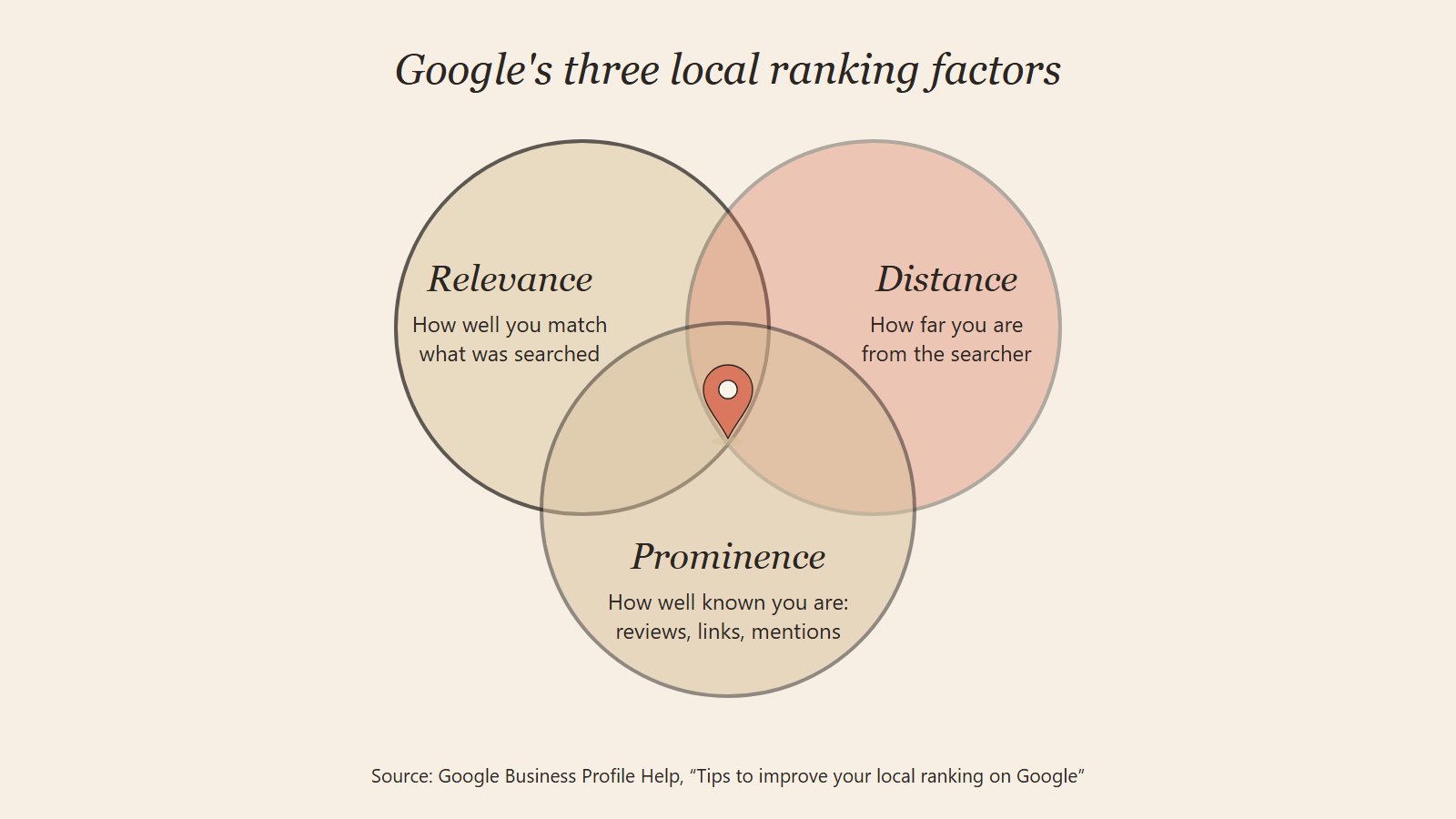
The summary line reads: "Local results are mainly based on relevance, distance, and popularity. Together, these factors help Google find the best match for customers’ searches."
Notice the wording. The summary sentence says "popularity," but the factor heading directly below it says "Prominence." Most guides quietly paraphrase this as "relevance, distance, prominence." Both words point at the same idea: how well known and well reviewed your business is.
| Factor | Google's exact words | What you can do about it |
|---|---|---|
| Relevance | "Relevance is how well a Business Profile matches what someone is searching for." | Pick the right primary category, list every service, write a clear description, and keep your website pages specific |
| Distance | "Distance refers to how far each business is from the customer who’s searching. If a customer doesn’t share where they are, Google uses what it knows about their location." | Very little. Use your real address or service area; never fake one |
| Prominence | "Prominence means how well-known a business is." Google adds that it is "based on info like how many websites link to your business and how many reviews you have." | Earn steady reviews, reply to them, get mentioned on relevant local and industry sites |
Google also says, word for word: "More reviews and positive ratings can help your business’s local ranking." And it warns: "There's no way to request or pay for a better local ranking on Google."
That last line matters when you are buying help. Anyone selling a "guaranteed top three map spot" is promising something Google says cannot be bought.
Local SEO vs regular SEO: what's the difference?
Regular SEO tries to rank your website for a topic anywhere a searcher happens to be. Local SEO tries to rank your business for searchers near a place you serve, and it adds the Business Profile and map pack to the job.
They overlap more than most people expect. A strong website helps your local rankings, and a well-known local business tends to earn links that help regular rankings.
| Regular SEO | Local SEO | |
|---|---|---|
| Who you want to reach | Anyone searching the topic, often nationwide | People in or near the area you serve |
| Main results area | Organic website listings | Map pack, Google Maps and organic listings |
| Core asset | Your website | Your Google Business Profile plus your website |
| Big ranking inputs | Content quality, links, technical health | Relevance, distance, prominence (Google's words) |
| Role of reviews | Indirect | Direct; Google names review count as a prominence signal |
| Location of the searcher | Matters a little | Changes the results street by street |
| Typical first win | A page ranking for a topic | Showing in the map pack for your main service |
If you sell online to the whole country, regular SEO does most of the work. If customers come to you, or you go to them, local SEO usually brings the faster return. Many businesses need both, which is why a good SEO audit checks the website and the Business Profile together.
Does your business need local SEO?
You need local SEO if customers find you by searching for a service in a place. That covers most shops, clinics, restaurants, trades and professional firms. Purely online businesses usually do not, because Google does not give them a Business Profile at all.
Google's Business Profile guidelines set the rules for who qualifies. A business must make in-person contact with customers during its stated hours, either at a location or by traveling to them. A virtual office or rented mailbox is not eligible.
| Your business type | Example | Need local SEO? | What Google expects |
|---|---|---|---|
| Storefront | Bakery, salon, dental clinic | Yes, it is the main channel | Show your real street address and hours |
| Service-area business | Plumber, cleaner, mobile mechanic | Yes | Set a service area; Google says to hide your address if customers do not visit it |
| Hybrid | Restaurant with delivery, garden center with installs | Yes | Show the address and add the areas you serve |
| Online-only | Online store, SaaS, remote consultancy | Rarely | Not eligible for a profile; focus on regular SEO |
| Multi-location | Clinic group, franchise | Yes, per location | One profile for each eligible location |
The service-area rule trips up a lot of home-based trades. Google's guidelines use a plumber working from home as the example and say the address should be removed from the profile. You still rank; you just rank for the area you serve rather than a pin on your house.
What does local SEO involve for a small business?
Local SEO for a small business comes down to six jobs: claim and complete your Business Profile, keep your details consistent everywhere, earn and answer reviews, build clear local pages on your site, get mentioned by relevant sites, and keep the site quick on phones. Most of the gains come from doing the first three properly.
Claim, verify and complete your Google Business Profile
Verification is the step that tells Google you are allowed to manage the listing. After that, fill in every field that applies: primary category, extra categories, services, hours, holiday hours, photos, and attributes like parking or wheelchair access. Google's ranking page says businesses with complete and accurate info are more likely to show up in local results.
Keep the business name exactly as it appears on your sign and paperwork. Google's guidelines say adding unnecessary information to the name is not permitted, and they give examples like tacking a neighborhood onto it. Keyword-stuffed names can get a profile suspended. Our Business Profile optimization guide walks through each field.
Keep your name, address and phone consistent
Your business name, address and phone number (often called NAP) should match on your website, your profile and the main directories: Bing Places, Apple Business Connect, Yelp, Facebook and the directories for your industry. Mismatched phone numbers or an old address confuse both Google and customers.
Earn reviews and reply to them
Reviews are the one prominence signal Google calls out by name. They also decide whether people pick up the phone. In the same BrightLocal 2026 survey, 31% of consumers said they will only use a business rated 4.5 stars or more, up from 17% a year earlier, and 74% look for reviews written in the last three months.
So steady beats sudden. Ask every happy customer, make it easy with a direct review link, and reply to every review, good and bad. BrightLocal found 80% of consumers are likely to use a business that responds to all of its reviews. Never buy reviews or offer discounts for them; that breaks Google's policies.
Build local pages on your website
Your website tells Google what you do in detail. Give each main service its own page, name the towns you actually serve, and add your address, phone and hours in the footer. Local keyword research helps here: check how people phrase the service ("AC repair" or "air conditioning repair") and use their words.
Avoid copy-paste town pages. On one tree service site we worked on, 18 town pages were 86% identical; we rewrote each around that town's own tree rules, and the site's average position moved from 33.0 to 12.5 over the following 28-day window. Structured data also helps machines read your details correctly; our guide to schema markup for AI search shows which types to add.
Get mentioned by relevant local and industry sites
Google's prominence factor counts "how many websites link to your business." Good local links come from real relationships: a supplier's dealer page, a trade association listing, a sponsorship of a local team, or a useful guest article on a reputable industry site. Skip paid link packages and spammy directories; they add risk without adding trust.
Make the site work on a phone
Most local searches happen on phones, often on the move. Your site should load quickly, show the phone number without scrolling, and let people tap to call or get directions. A slow mobile page wastes every ranking gain you made elsewhere.
How do you measure local SEO, and how long does it take?
Measure local SEO by the actions customers take, not just by rankings. The useful numbers are calls, direction requests, website clicks and form fills from Google, compared month to month.
Three free sources cover most of it:
- Business Profile performance: shows searches, calls, direction requests and website clicks from your listing
- Google Search Console: shows which local searches your website appears for, and where it ranks
- Your own records: booked jobs, call tracking or a simple "how did you hear about us?" question
Rankings change street by street, so one rank check from your office says little. Track your main service terms from a few points across your area instead.
On timing, cleanup work such as fixing a wrong phone number, completing the profile or correcting broken site data often shows results within weeks. On an auto repair site we worked on, Google read 369 reviews as "0.0 rating, 0 reviews" on 30 of its 58 pages; after we fixed that and rebuilt 22 thin service pages, monthly phone calls from Google search went from 3 to 25. Building prominence through reviews and links is slower and usually takes several months of steady work.
Frequently Asked Questions
What is local SEO in simple words?
Local SEO is making sure your business shows up when people near you search for what you offer. It covers your Google Business Profile, your reviews, your listings on other sites and your website's local pages.
Is local SEO different from Google Business Profile optimization?
Yes. Business Profile optimization is one part of local SEO. Local SEO also includes your website pages, consistent listings across directories, reviews and mentions from other sites, all of which feed Google's relevance and prominence factors.
Can a business without a storefront do local SEO?
Yes, as long as it serves customers in person. Google lets service-area businesses set the areas they cover and tells them to hide a home address, so plumbers, cleaners and mobile services can still rank in the map pack.
Can I pay Google to rank higher in local results?
No. Google's help page states there is no way to request or pay for a better local ranking. You can buy ads that appear above or inside local results, but those are labeled as sponsored and do not change your organic map ranking.
How much does local SEO cost?
It depends on how many locations you have, how competitive your area is and how much cleanup is needed first. Our local SEO pricing guide covers market ranges, and many of the basics are things you can do yourself with our local SEO checklist.
Does local SEO help me show up in ChatGPT?
It helps. AI assistants draw on reviews, business listings and website content when they recommend local businesses, so accurate, consistent details and strong reviews make you easier to recommend. Checking what these tools currently say about you is part of any modern AI SEO service.
Get a free local and AI SEO audit
Not sure why competitors show up in the map pack and you do not? Start with a free AI SEO audit. We check your Business Profile against Google's guidelines, compare your listings and reviews with the businesses outranking you, test your website's local pages, and see what ChatGPT and Google's AI answers say about you. You get a short, ranked list of what to fix first, and a fixed-scope quote only if you want help doing it.
WhatsApp our team, email info@speedxmarketing.com, or reach us through our contact page. We read every message and reply with next steps.
The SpeedX Marketing team