Key takeaways:
- Google says there are no extra technical requirements for AI Overviews or AI Mode beyond being indexed and eligible for a snippet.
- Google's July 2026 optimization guide says you don't need llms.txt files, tiny content chunks or a special writing style for its AI features.
- Search Console now has a Generative AI performance report, and Bing Webmaster Tools has an AI Performance report, so you can measure AI visibility for free.
- OpenAI's documentation says ChatGPT search relies on OAI-SearchBot, and robots.txt changes take about 24 hours to apply.
You've read what answer engine optimization is, and maybe skimmed a few playbooks. What most people still lack is an AEO strategy they can actually run on a Monday morning, with a clear signal for when each step is finished. That's what this checklist is.
It's written for small and mid-sized businesses doing the work in-house or checking an agency's plan. If you want the bigger picture first (how AI tools retrieve and cite pages, the content types that earn citations, and a 90-day rollout), read our 2026 playbook on getting cited in ChatGPT. This post skips that theory and goes straight to the order of operations, the tests, and the traps.
What should an AEO strategy include before you start?
An AEO strategy needs three things in place before step one: a site that Google and Bing already index, someone who owns the work each month, and a short list of the services or products you most want to be named for. Without those, the checklist turns into scattered tweaks.
Pick a narrow starting scope
Choose two or three money topics, not your whole site. A plumbing company might pick "water heater replacement" and "emergency drain clearing." A software firm might pick its core product category and one comparison it often loses. A narrow scope lets you see cause and effect within a few weeks.
Set one owner and one calendar slot
AEO is mostly maintenance. Put a recurring 2 to 3 hour block on someone's calendar each month for the prompt check, the reports and the page updates. If nobody owns it, the baseline you record in step one never gets compared against anything.
Know where AEO ends and SEO starts
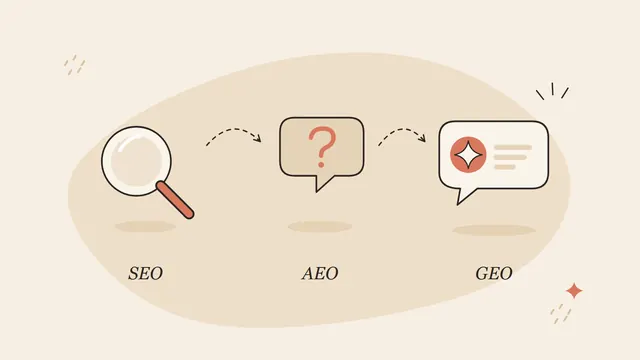
The two overlap heavily, which Google states plainly. Its guide to optimizing for generative AI features, updated in July 2026, says optimizing for AI search "is optimizing for the search experience, and thus still SEO." Our post on AEO vs SEO covers the split in detail. For this checklist, assume your basic SEO is sound and focus on what changes how answers get written.
The AEO best practices checklist, step by step
These ten steps run in order the first time, then on a monthly loop. Each one ends with a "done when" line, so you know when to stop polishing and move on.
Step 1: Run a baseline prompt check
Write 15 to 25 prompts a real buyer would type into ChatGPT, Perplexity, Gemini, Copilot or Google's AI Mode. Mix three kinds: problem prompts ("why does my water heater make a popping noise"), shopping prompts ("best water heater installer for a two-bathroom house") and brand prompts ("is [your business] reliable"). Run each one in a logged-out or private window and record the result.
Score every answer the same way:
- Named: your business appears in the answer text.
- Cited: your page appears as a linked source.
- Accurate: what the answer says about you is correct.
- Competitors: which other businesses or sites show up instead.
Answers vary from run to run, so treat one check as a snapshot, not a verdict. Our guide to AI search citation tracking explains how to repeat this without paying for a tool.
Done when: you have a spreadsheet with every prompt, the date, and the four scores for each AI tool.
Step 2: Collect the questions your customers actually ask
The best question list comes from your own records, not a keyword tool. Pull questions from sales call notes, quote request forms, support emails, live chat logs and the questions people leave in reviews. Then add Google's "People also ask" boxes for your main topics.
Write each question the way a person would say it out loud. AI prompts are longer and more conversational than old search terms, so "how much does it cost to replace a 50 gallon gas water heater" is more useful than "water heater cost." Keep the exact wording; it tells you what the answer must contain.
Done when: each money topic has 10 to 30 real questions, grouped by intent (learning, comparing, buying, fixing).
Step 3: Match each question to the right answer format
Different questions want different shapes of answer. An answer engine lifts whatever shape fits the question best, so the format is part of the answer.
| Question type | Example | Format that gets lifted | Where it goes |
|---|---|---|---|
| Definition | "What is a tankless water heater?" | One plain 2 to 3 sentence definition | First lines under a question heading |
| Cost | "How much does X cost?" | A range, what drives it, a small table | Service or cost page |
| Comparison | "X vs Y for a small office?" | Side-by-side table plus a one-line verdict | Dedicated comparison page |
| Process | "How do I do X?" | Numbered steps, one action each | How-to post or service page section |
| Yes/no | "Do I need a permit for X?" | "Yes" or "No" first, then the condition | FAQ block |
| Trust | "Is [business] legit?" | Facts: years, reviews, licences, policies | About page, Business Profile, review sites |
Done when: every question on your list has a format and a target page next to it.
Step 4: Rewrite your best existing pages answer-first
Start with pages that already rank on page one or two for your topics, because answer engines draw heavily from pages search engines already trust. For each question assigned to that page, add a heading phrased as the question, then answer it in the first one or two sentences. Put the supporting detail, examples and caveats after the answer, not before it.
Make facts checkable. Swap "affordable pricing" for the actual range, "fast service" for the actual response time, and "experienced team" for the real number of years. Name your sources when you quote a figure. Vague claims give an AI summarizer nothing it can safely repeat.
Done when: the top 5 to 10 pages each answer their assigned questions within the first lines under a matching heading, with no unsupported claims.
Step 5: Confirm answer engines can reach the page
A page an engine can't fetch can't be quoted. Google's Search Central page on AI features says a page must be "indexed and eligible to be shown in Google Search with a snippet," and recommends making sure crawling is allowed in robots.txt and by any CDN or hosting setup. That last part matters: firewall and bot-protection settings often block crawlers that robots.txt allows.
Check three things on each target page:
- Index status: use URL Inspection in Search Console and the URL Inspection tool in Bing Webmaster Tools.
- Snippet controls: make sure nobody set
nosnippet,data-nosnippetor a tinymax-snippeton the content you want quoted. Google names these as the controls that limit what its AI features can show. - ChatGPT access: OpenAI's crawler documentation says OAI-SearchBot is the bot that surfaces sites in ChatGPT search, and that robots.txt changes take about 24 hours to take effect. Blocking GPTBot (training) is a separate choice from blocking OAI-SearchBot (search).
The full list of AI crawlers and what each one does is in the playbook's technical section, so we won't repeat it here.
Done when: every target page is indexed in Google and Bing, has no snippet restriction on its answer text, and is reachable by the search bots you want.
Step 6: Add schema that mirrors the page
Structured data helps engines confirm who you are and what a page covers, but only when it describes what a visitor can actually see. Google's AI features page lists "making sure your structured data matches the visible text on the page" as a best practice, and its July 2026 guide says there is no special schema you need to add for AI search.
So keep it honest and basic: Organization or LocalBusiness on the site, Article on posts, Product or Service where it fits, and FAQ markup only on real question-and-answer content. Our post on schema markup for AI search has the property-by-property detail.
Done when: each target page passes the Schema Markup Validator (or Google's Rich Results Test for rich result types), and every marked-up fact appears in the visible text.
Step 7: Put facts on a refresh schedule
Prices, hours, staff, service lists and policies go stale, and an answer engine will happily repeat an old number. Bing says this directly: its February 2026 announcement of the AI Performance report advises regular updates so AI systems reference current content, and recommends IndexNow to tell participating engines when a page is added, changed or removed.
Give every page that carries a fact a review date. Quarterly works for most service pages; monthly for anything with prices or availability. When you change a page, change the visible "last updated" date only if the content really changed.
Done when: each target page has an owner and a next-review date, and your site pings IndexNow on updates (many CMS plugins and hosts do this automatically).
Step 8: Make your business facts agree everywhere
AI answers about your business are assembled from many sources, not just your site. If your website says you open at 8, your Google Business Profile says 9 and an old directory says 7, the engine has to guess. Consistency is the cheapest trust signal you can control.
Line up your name, address, phone, hours, services and service area across your website, Google Business Profile, Bing Places for Business (which feeds Microsoft's AI answers), Apple Business Connect and the two or three directories that matter in your industry. Then work on honest mentions: genuine customer reviews, guest posts on relevant, reputable sites in your field, and helpful answers in communities where your customers already ask questions. Google's July 2026 guide warns that "seeking inauthentic 'mentions' across the web isn't as helpful as it might seem," so skip anything paid or fake.
Done when: your core business facts are identical across every profile you control, and you have a short list of real places to earn mentions over the next quarter.
Step 9: Measure with first-party reports
You no longer need to guess whether Google's AI features show your pages. Google's June 2026 announcement of the Generative AI performance reports describes a separate Search Console view of impressions in AI Overviews, AI Mode and generative AI features in Discover, broken down by page, country, device and date. It rolled out to all sites by August 31, 2026.
Bing's AI Performance report does the same for Microsoft Copilot, AI summaries in Bing and select partner integrations. It shows total citations, which pages are cited, and sample "grounding queries," the phrases the AI used when it retrieved your content. Those grounding queries are a free list of the questions engines think you answer.
| What to watch | Where | What it tells you |
|---|---|---|
| AI impressions by page | Search Console, Generative AI report | Which pages Google's AI features show |
| Citations and grounding queries | Bing Webmaster Tools, AI Performance | Which pages Copilot cites, and for what |
| Visits from chatgpt.com, perplexity.ai, gemini.google.com, copilot | Google Analytics, referral sources | Whether AI answers send people who act |
| Named, cited, accurate scores | Your step 1 spreadsheet | Movement in the tools that have no report |
| Leads that mention AI | Intake form "how did you hear about us" | Whether any of it turns into revenue |
Done when: both reports are bookmarked, AI referrals have their own saved view in analytics, and your intake form asks how the lead found you.
Step 10: Review monthly and repeat
Once a month, rerun the step 1 prompts, compare the reports with last month, and pick the next three pages to improve. Pages that earn AI impressions but few citations usually need a clearer answer near the top. Pages with no AI visibility at all usually have an access or indexing problem from step 5.
Keep a simple change log: the date, the page, what you changed. Without it, you can't tell which edits moved the numbers.
Done when: you have a dated change log and three pages chosen for next month.
How does AEO differ across Google, ChatGPT, Copilot and Perplexity?
The steps above work everywhere, but each engine pulls from a different index and reports differently. Knowing where each one looks tells you which profile or tool to fix first.
| Engine | Where it finds pages | What to check first | Free measurement |
|---|---|---|---|
| Google AI Overviews and AI Mode | Google's search index; may run several related searches per question | Indexed, snippet-eligible, Google Business Profile complete | Search Console Generative AI report |
| ChatGPT search | Pages OpenAI's OAI-SearchBot is allowed to reach | OAI-SearchBot allowed in robots.txt and the CDN | Analytics referrals from chatgpt.com, prompt checks |
| Microsoft Copilot | Bing's index | Bing Webmaster Tools verified, IndexNow on, Bing Places current | Bing AI Performance report |
| Perplexity | Its own crawler and live web search, with numbered source links | PerplexityBot not blocked, pages answer the exact question | Analytics referrals, prompt checks |
| Voice assistants | Mostly the search engine behind each assistant | Short, direct answers and accurate business profiles | Prompt checks by voice |
Google notes on its AI features page that both AI Overviews and AI Mode may use a "query fan-out" technique, issuing several related searches across subtopics. In practice, that rewards pages that answer the follow-up questions too, not just the headline one. A cost page that also covers timing, permits and warranty has more chances to be pulled in than one that only lists a price.
Which AEO "best practices" can you skip?
A lot of AEO advice online is untested, and some of it contradicts what the search engines themselves publish. Google's July 2026 guide includes a section on what you don't need to do, which is a useful filter for any checklist, this one included.
| Advice you'll hear | What the primary source says | What to do instead |
|---|---|---|
| "Add an llms.txt file to rank in AI answers" | Google says its Search "doesn't use" new AI text or Markdown files, though keeping one for other services is harmless | Spend the time on step 4 rewrites |
| "Chop content into tiny chunks for AI" | Google: "There's no requirement to break your content into tiny pieces" | Use clear headings and answer-first sections on normal pages |
| "Write in a special style for AI" | Google: "You don't need to write in a specific way just for generative AI search" | Write plainly for the customer; specifics beat style |
| "You need special AI schema" | Google: "there's no special schema.org markup you need to add" | Keep basic schema accurate (step 6) |
| "Buy mentions to get recommended" | Google says inauthentic mentions aren't as helpful as they seem | Earn reviews and relevant guest posts (step 8) |
| "This tool sees Google's AI ranking data" | Google: "No third-party tool has access to our internal ranking or AI systems" | Trust Search Console and Bing data first |
None of this means paid visibility tools are useless. They can save time on prompt checks across many engines. It means their numbers are estimates, and the free first-party reports are the ground truth for Google and Bing.
What do you do when an AI tool gets your business wrong?
Fix the source, not the answer. AI tools repeat what they find, so a wrong price or old address usually traces back to a page or profile that still says it.
Find where the wrong fact came from
Run the prompt again in a tool that shows sources, such as Perplexity, ChatGPT search or Google AI Mode, and open each cited link. Check Bing's grounding queries for the same topic. The culprit is usually an outdated page on your own site, an old directory listing, or a third-party article that was right two years ago.
Correct it and tell the engines
Update your own page first, then your Google Business Profile and Bing Places listing, then ask any directory or site owner to correct their copy. Request a recrawl with URL Inspection in Search Console and submit the URL through IndexNow for Bing. Most AI tools also have a feedback button on each answer; use it, but treat it as a bonus, not the fix.
Publish the plain answer
If the mistake comes from a question nobody on the web answers clearly, answer it yourself. A short, dated section such as "Do you still offer weekend service? Yes, Saturdays 9 to 2" gives the engine a better source than the stale one. Recheck the prompt in two to four weeks.
How long does an AEO strategy take to show results?
Expect early movement in weeks and steady results over a few months. Access fixes can show quickly, since OpenAI says robots.txt changes reach ChatGPT search in about a day, but content changes wait on recrawling, and authority work builds slowly.
The order matters more than the speed. In one of our own cases, a luxury landscaping company had lost three-quarters of its Google impressions in three months after 487 guide articles were redirected to sales pages. We rebuilt the redirects, recovered 45 lost guides, added 224 FAQs and removed a fake review rating from the site's code. Comparing the 28 days before with the most recent 28 days, its Google AI answer appearances went from 740 to 3,801 and its average position improved from 22.9 to 9.8.
Notice that none of that was clever AI work. It was steps 4, 5 and 6 done thoroughly on pages the site already had. That's why the checklist starts with existing pages: fixing what is broken usually beats publishing something new.
Frequently Asked Questions
What is an AEO strategy?
An AEO strategy is a written plan for getting your pages quoted or cited inside AI answers, from Google's AI Overviews to ChatGPT and Copilot. It covers which questions you'll answer, which pages answer them, how engines reach those pages, and how you'll measure the results each month.
Is AEO different from SEO?
AEO is a focus within SEO, not a replacement for it. Google's own guidance says optimizing for its AI features is still SEO, so indexing, helpful content and technical health all carry over. The difference is the goal: AEO aims for your passage to be the one an answer quotes, and it is measured by AI impressions and citations as well as clicks.
How long does answer engine optimization take?
Access fixes can show in days, and answer-first rewrites usually need a few weeks for recrawling. Off-site trust, such as reviews and mentions, builds over months. Plan on a monthly review loop rather than a one-time project.
Do I need an llms.txt file for AEO?
Not for Google. Google's July 2026 optimization guide says its Search doesn't use these files, though keeping one for other services does no harm. Your time is better spent making key pages answer questions clearly.
What tools do I need to measure AEO?
Start with the free ones: Search Console's Generative AI report, Bing Webmaster Tools' AI Performance report, and AI referral traffic in your analytics. Add a monthly manual prompt check for ChatGPT, Perplexity and Gemini. Paid visibility tools can speed up prompt tracking, but their numbers are estimates.
Does AEO work for local businesses?
Yes, and local businesses often see results faster because the competition for local questions is thinner. Accurate Google Business Profile and Bing Places listings, real reviews, and service pages that answer cost, timing and area questions do most of the work.
Get a free AEO baseline for your business
Not sure where to start? We'll run the step 1 prompt check for your top topics, review your Search Console and Bing AI data, and send you a short list of the pages and profiles to fix first. It's free, and you keep the findings whether or not you work with us. If you'd rather hand the whole loop to a team, see our AI SEO services; any work after the audit comes as a fixed-scope plan.
To book it, WhatsApp our team, email info@speedxmarketing.com, or use our contact page. The team at SpeedX Marketing will take it from there.