Key takeaways:
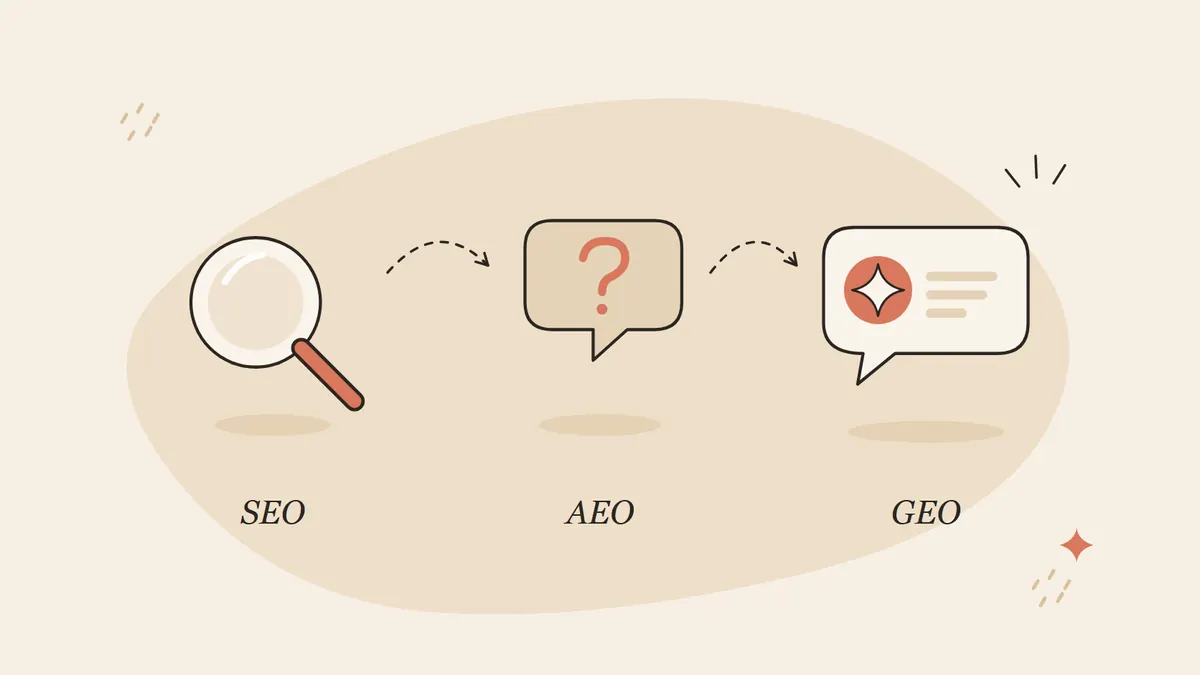
- SEO wins a click, AEO wins the quoted answer, and GEO wins a mention or citation inside an AI-written reply.
- Google says you cannot mark up a page to become a featured snippet, and that AI Overviews need no special optimization beyond normal indexing.
- The term GEO comes from a 2023 research paper accepted at KDD 2024; AEO is an older industry label tied to snippets and voice assistants.
- LLM SEO, LLMO and AI SEO are marketing labels for the same AI-answer work, not separate disciplines.
- Most of the effort overlaps; the real differences are the surface you appear on and how you measure success.
SEO vs AEO vs GEO is the question we hear most from owners who just received three proposals using three different acronyms. Underneath the labels, SEO vs AEO vs GEO is really about one shift: customers now get answers from a results page, a quoted answer box and a chatbot, sometimes all in the same afternoon.
This pillar puts the three side by side. You will get a plain definition of each, a comparison table, an honest look at whether GEO and AEO are even different, a map of the newer labels like LLM SEO, and a task-by-task matrix showing which work feeds which channel. Claims about how Google, OpenAI and Perplexity behave link straight to their own documentation, not to vendor blogs.
What do SEO, AEO and GEO each mean?
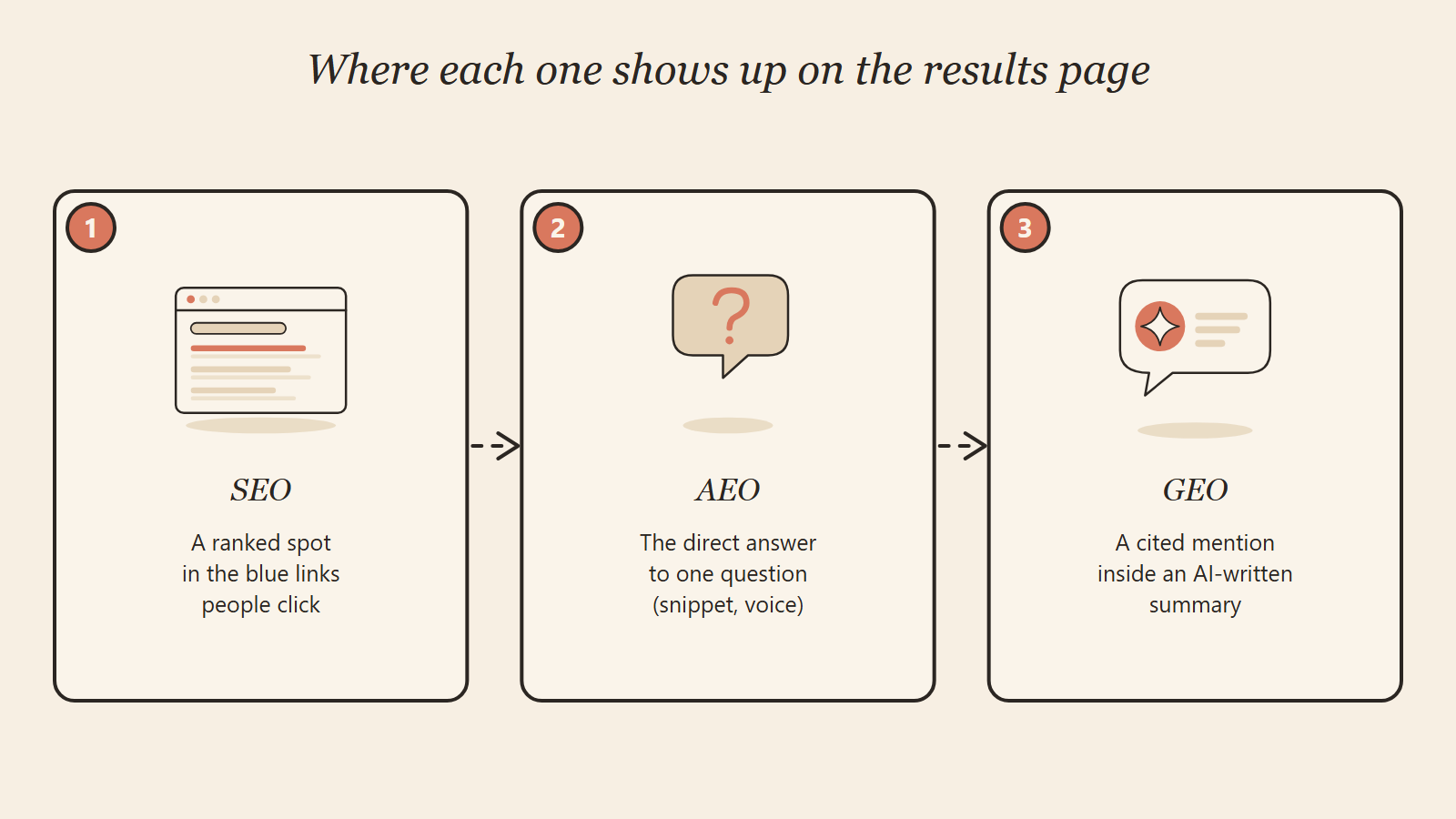
Each term names the place you want to show up. SEO targets the list of links, AEO targets the one answer pulled out of a page, and GEO targets the paragraph an AI model composes from several sources.
SEO: search engine optimization
SEO is the oldest of the three and the base for the other two. You make pages crawlable and fast, match them to what people search, and build trust through links, reviews and consistent business details. The scoreboard is rankings, clicks and the leads those clicks produce.
AEO: answer engine optimization
AEO grew up around featured snippets, People Also Ask boxes and voice assistants that read one answer aloud. The goal is to be the extracted answer: a tight, self-contained reply directly under the question it answers. Google describes featured snippets as results where the usual format is reversed so the descriptive text shows first, and its featured snippets documentation is blunt that you cannot mark a page up to win one; Google's systems decide.
GEO: generative engine optimization
GEO is the newest label. It was named in the paper "GEO: Generative Engine Optimization" by Pranjal Aggarwal and colleagues, first submitted in November 2023 and accepted to KDD 2024. Testing on a benchmark of queries they called GEO-bench, the authors reported that their methods could raise a source's visibility in generative engine responses by up to 40%. Success means ChatGPT, Perplexity, Gemini, Copilot or Google's AI features mention your business or cite your page while writing an answer.
How do SEO, AEO and GEO compare side by side?
The cleanest way to separate them is by surface, prize and scoreboard. Content quality, crawl access and trust run underneath all three columns.
| SEO | AEO | GEO | |
|---|---|---|---|
| Where you appear | Ranked links on a results page | A featured snippet, a People Also Ask reply, a voice assistant answer | Inside a written reply from ChatGPT, Perplexity, Gemini, Copilot, AI Overviews or AI Mode |
| The prize | A visit to your site | Being the one answer shown or spoken | Being named or cited among several sources |
| Typical query | "roof repair cost" | "how long does a roof repair take" | "which roofer near me handles insurance claims and what should I ask them" |
| What it rewards | Relevance, technical health, links, reviews | Short, direct answers under question headings | Clear facts with sources, consistent entity details, third-party mentions |
| Main measurement | Positions, clicks, conversions in Search Console and analytics | Snippet and PAA wins, impressions on question queries | Prompt-test mention rate, AI referral visits, citation share |
| Click outcome | Click is the goal | Often no click; the answer is the result | Sometimes a cited link, often just a brand mention |
Read across a row and you will notice AEO sits between the other two. It shares SEO's surface (Google's own results page) and GEO's goal (being the words the machine repeats). That middle position is why the labels blur so often.
Is GEO different from AEO?
Partly. Both chase the moment a machine answers instead of listing links, so the writing habits overlap heavily. The difference is scope: AEO aims at one extracted answer, while GEO aims at a share of a longer, synthesized response that blends several sources.
Where GEO vs AEO really differ
- Answer shape: AEO wants one paragraph a system can lift whole. GEO wants your facts and brand to be one of several voices in a composed reply.
- Where signals come from: AEO is mostly on-page work. GEO leans harder on what other sites say about you, since AI tools often cite review platforms, directories, forums and articles.
- Which systems: AEO grew around Google's snippet features and voice assistants. GEO covers chat-style tools that run their own searches, each with its own crawler.
Why the line keeps blurring
Google's AI Overviews and AI Mode are both an answer box and a generative engine at once. Google's AI features documentation says these features may use "query fan-out," running several related searches across subtopics before building a reply. A page that answers one subtopic cleanly (an AEO habit) becomes one of the cited sources in a blended answer (a GEO outcome).
So when a vendor says "we do AEO, not GEO," ask what they would do differently on your site. Usually the honest answer is "very little," and that is fine. For a closer look at each pairing, read our GEO vs SEO comparison.
Where do LLM SEO, LLMO and AI SEO fit?
They are alternative names for the same AI-answer work, mostly GEO with some AEO mixed in. None of them is a separate discipline with its own rulebook.
| Label you may see | What it usually means | Closest of the three |
|---|---|---|
| LLM SEO / LLMO | Getting large language models to mention or recommend you | GEO |
| AI SEO | SEO plus the answer and citation work for AI tools | SEO + AEO + GEO |
| AIO (AI optimization) | A broad umbrella for visibility in AI systems | GEO |
| GSO (generative search optimization) | Visibility in AI features built into search engines, such as AI Overviews | AEO + GEO |
| "GEO" meaning geographic | Local targeting for "near me" searches | Local SEO, not generative |
The practical test for any label is the same: ask which surface the seller is targeting and how they will prove progress. If they cannot name a surface and a metric, the acronym is decoration. Our breakdown of AI SEO, AEO and GEO pricing shows how those labels tend to show up on real quotes.
What does Google say about AEO and GEO?
Google's position is that the same SEO fundamentals cover its AI features. Its AI features page states there are "no additional requirements to appear in AI Overviews or AI Mode, nor other special optimizations necessary," beyond being indexed and eligible to show with a snippet.
John Mueller of Google Search Relations made the same point in a May 2025 Search Central post, Top ways to ensure your content performs well in Google's AI experiences. His first recommendation is to focus on "unique, non-commodity content," followed by page experience, crawlable pages, structured data that matches the visible text, and current business details. He also wrote that clicks from AI Overviews tend to be "higher quality," with visitors more likely to spend time on the site, and suggested judging visits on sales, signups and engagement rather than raw click counts.
Outside Google, the rules are written in each company's crawler documentation. OpenAI's bots page says sites that opt out of OAI-SearchBot "will not be shown in ChatGPT search answers," while GPTBot is the separate crawler tied to model training. Perplexity's crawler guide describes PerplexityBot as the crawler that surfaces and links sites in its results, and says it is not used to train foundation models.
The takeaway: no engine publishes a secret GEO switch. What they publish are access rules, and a site that blocks the wrong bot quietly drops out of that engine's answers.
Which work helps SEO, AEO and GEO?
Most of the work feeds two or three channels at once. Sorting your list this way stops you paying three times for the same task.
| Task | SEO | AEO | GEO |
|---|---|---|---|
| Fix indexing, sitemaps and broken redirects | High | High | High |
| Allow Googlebot, Bingbot, OAI-SearchBot and PerplexityBot in robots.txt and at your CDN | High | Medium | High |
| Put a 40 to 60 word answer under each question heading | Medium | High | High |
| Add FAQ blocks written in the way customers phrase questions | Medium | High | Medium |
| Cite statistics with a named, linked source | Low | Medium | High |
| Keep business name, address, phone and services identical across listings | High (local) | Medium | High |
| Earn reviews and mentions on trusted outside sites | High | Low | High |
| Guest posts on relevant, reputable sites | High | Low | Medium |
| Structured data that matches what the page shows | Medium | Medium | Medium |
| Comparison tables and clear definitions | Medium | High | High |
| Monthly prompt testing across AI tools | Low | Low | High |
Two patterns stand out. The top rows are pure foundation, and they score high everywhere, so they come first. The bottom half is where AEO and GEO add something new: answer-first writing, sourced facts, outside reputation and a new way of measuring. Our ChatGPT citation playbook walks through that second layer in detail.
What schema can and cannot do
Structured data helps machines read a page, but it does not force an outcome. Google says no markup makes a page a featured snippet, and its AI features need no special markup. Treat schema as tidy labelling that must match the visible page, not as a shortcut past the content work.
How do you measure each one?
Each discipline needs its own scoreboard, and the three should sit in one monthly report. Reporting them separately hides the cause-and-effect between them.
Measuring SEO
Use Google Search Console for impressions, clicks and average position, then analytics for leads and calls. Google notes that AI Overviews and AI Mode traffic is reported inside the normal "Web" search type, so it is blended into these totals rather than shown on its own.
Measuring AEO
Track which question queries show your page in a featured snippet or People Also Ask, and watch impressions on those queries in Search Console. A rising impression count with a flat click count on question queries often means you are being shown as the answer.
Measuring GEO
Ask a fixed set of 20 to 30 buyer-style prompts in ChatGPT, Perplexity, Gemini and Copilot each month and log whether you are named and which source gets credit. Add AI referral visits from those tools in analytics. Our guide to AI search citation tracking sets the method up step by step.
What does it look like when all three move together?
Here is a result from our own work. A luxury landscaping company's Google impressions had fallen 76% in three months. A crawl found 487 guide articles redirected to sales pages, so Google treated them as gone, and the site displayed a 5.0 rating from 2,900 reviews that did not exist.
The fixes were mostly SEO and AEO: 589 redirects rebuilt, 45 lost guides recovered, 224 FAQs added and the false rating removed. Comparing the 28 days before with the most recent 28 days, Google AI answer appearances went from 740 to 3,801, impressions doubled, and average position improved from 22.9 to 9.8.
No step in that project was a GEO trick. The AI appearances climbed because the answers existed again on pages Google could reach. That is the pattern we see repeatedly: the foundation lifts all three numbers at once.
Which should a small business do first?
Start with SEO, add AEO habits as you write, and build GEO on top. Treating them as three budgets usually means paying twice for the same foundation.
- Make it reachable: confirm key pages are indexed, the sitemap is current, and search and AI crawlers are allowed.
- Make it quotable: restructure service pages and posts so each question heading opens with a direct answer.
- Make it checkable: back claims with named sources and keep business details identical everywhere.
- Make it talked about: earn reviews and mentions on outside sites your buyers already trust.
- Make it visible in one report: rankings, snippet wins and AI mentions, side by side, every month.
If you want the earlier piece of this series, our AEO vs SEO comparison goes deeper on the answer-box layer. If you would rather hand all three to one team, look for AEO and SEO services sold as one plan rather than as separate add-ons. Our AI SEO services work that way.
Frequently Asked Questions
What is the difference between SEO, AEO and GEO?
SEO ranks your pages in search results so people click through. AEO shapes content so one direct answer is pulled from your page, and GEO works to get your brand cited inside AI-written replies. All three rely on the same crawlable, trustworthy site.
Is GEO the same as AEO?
Not quite, but they overlap heavily. AEO targets one extracted answer, such as a featured snippet, while GEO targets a mention among several sources in a composed AI answer. On most sites the writing work is nearly identical.
What is LLM SEO compared with GEO and AEO?
LLM SEO is another name for getting large language models to mention or recommend you, which is essentially GEO. It is a marketing label, not a separate method, so ask any vendor which surfaces and metrics they mean by it.
Does GEO or AEO replace SEO?
No. AI search features and answer boxes draw from pages that are already crawled and indexed. Google says its AI Overviews and AI Mode need nothing beyond normal indexing and snippet eligibility, so weak SEO caps how far AEO and GEO can go.
Which should I optimize for first?
SEO first, because nothing else works if your pages cannot be found. Write new content in an answer-first format from day one, which covers AEO at little extra cost, then add GEO work like outside mentions and prompt testing.
How long does it take to show up in AI answers?
It depends on your starting point. A site that is already indexed and trusted can appear in AI answers within weeks of rewritten pages being recrawled, while a site with crawl or redirect problems needs those fixed first, which sets the pace.
Get a free AI SEO audit across all three
Not sure which of the three is holding you back? Ask for a free AI SEO audit. We check whether your important pages are indexed, whether search and AI crawlers can reach them, which question queries you already answer, and how often AI tools name you for the prompts your buyers use. You keep the findings either way.
To start, WhatsApp our team, email info@speedxmarketing.com, or use our contact page. The team at SpeedX Marketing will reply with a fixed-scope next step.