Key takeaways:
- SparkToro's June 2026 study found 68.01% of US Google searches from January to April 2026 ended without a click, up from about 49% in 2019.
- Pew Research Center found AI summaries appeared on 60% of question-style searches but only 8% of one- or two-word searches.
- Search Console counts an impression whenever a link to your site is shown or potentially shown, even if nobody clicks.
- For local businesses, many "lost" clicks reappear as Business Profile calls and direction requests.
- Clicks alone now undercount what search does for you; track impressions, branded searches, calls, and AI citations too.
The zero click search has gone from an SEO talking point to the default way people use Google. Someone types a question, reads the answer at the top, and closes the tab. If your reports only count website visits, that looks like your marketing is failing, even when your business is the one being shown.
This guide explains what counts as a zero-click search, how common it is in 2026, which of your keywords it affects, and what to change. You'll also get two tables: one that sorts query types by how likely they are to send a click, and one that lists what to measure instead, with the exact report where each number lives. Our team at SpeedX Marketing runs this check on every audit, because the answer changes what a business should spend on.
What is a zero-click search?
A zero-click search is a query where the person gets what they need from Google's results page and never opens a third-party website. It's an industry label rather than a Google metric, and the best-known measurements of it come from SparkToro, the audience research firm run by Rand Fishkin.
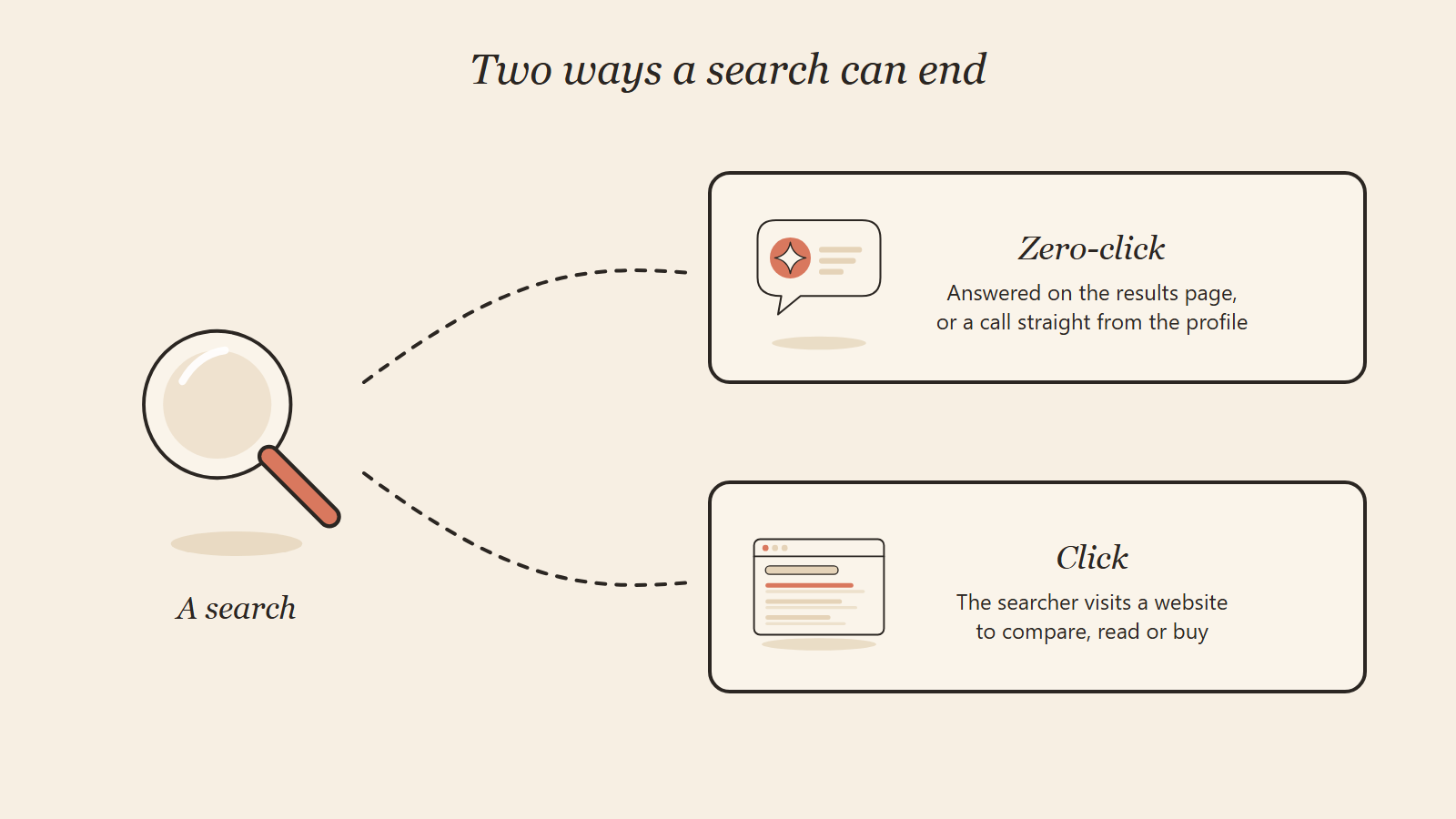
The answer can arrive in several formats, and each one affects you differently:
| Result type | What the searcher sees | Typical outcome for a business |
|---|---|---|
| AI Overview | A written summary with a few linked sources | You may be cited by name with no visit |
| Featured snippet | A quoted paragraph or list from one page | Brand seen, click optional |
| Local pack / Maps | Three nearby businesses with ratings and buttons | Call or directions tap instead of a site visit |
| Knowledge panel | Facts about a company, person, or thing | Hours, phone, and reviews read on Google |
| Instant answer | Weather, time, calculator, conversions | No business value either way |
| People Also Ask | Expandable questions with short answers | Some clicks, mostly reading |
Notice the local pack row. A searcher who taps "Call" on your listing never reaches your website, so analytics records nothing. That's still a lead.
How common are zero-click searches in 2026?
Most Google searches now end without a click. In SparkToro's 2026 zero-click study, published in June 2026 using Similarweb's clickstream panel, 68.01% of US Google searches between January and April 2026 ended with no click at all. The same series measured 60.45% in 2024 and about 49% in 2019.
Fishkin points to AI Overviews as the likely driver of the jump and notes they now appear on more than one in five searches. Google's separate AI Mode was still small in that window: only 0.34% of searches moved into it.
The earlier SparkToro and Datos study from 2024 adds a sharper detail. For every 1,000 US Google searches, only 360 clicks reached a website that Google doesn't own and that isn't a paid ad. That's the pool every organic result is competing for.
Which searches trigger AI answers most?
Long, question-style searches are hit hardest. Pew Research Center's 2025 analysis of 68,879 real searches by 900 US adults found that 60% of searches phrased as questions produced an AI summary. Searches of ten words or more produced one 53% of the time, while one- or two-word searches did so only 8% of the time.
Pew also found that 26% of page visits with an AI summary ended the person's browsing session entirely, against 16% without one. In plain terms, the summary often is the last thing they read.
Why are zero-click searches growing so fast?
Google keeps answering more on its own page because it's faster for the searcher. Every new result type, from the local pack to AI Overviews, removes one step between the question and the answer.
Three forces stack up here:
- AI Overviews summarize several pages into one answer, so the searcher rarely needs to open any of them.
- Phones make scrolling to the tenth result unlikely; the top of the screen is the whole page for many users.
- Business Profiles let people call, get directions, read reviews, and check hours without leaving Maps.
None of this is going to reverse. The useful question is which of your searches are affected and what each one is still worth.
Which searches end without a click, and which still send visitors?
Simple factual questions go zero-click; searches that need a decision, a comparison, or a provider still send visitors. Use this table to sort your own keyword list before you decide where to put effort.
| Query type | Example | Zero-click risk | What to do |
|---|---|---|---|
| Definition or quick fact | "what is a load-bearing wall" | Very high | Answer it well to earn the citation; don't expect traffic |
| How-to with one short answer | "how often to change HVAC filter" | High | Put the answer in the first lines; add depth for the readers who stay |
| Local "near me" or service + city | "emergency plumber near me" | High for the site, low for the business | Win the Business Profile; calls happen there |
| Brand name search | "your business name hours" | High | Keep hours, phone, and services identical on your site and profile |
| Comparison or "best" | "metal vs shingle roof cost" | Medium | Detailed tables and real numbers pull clicks |
| Cost and pricing | "how much does a dental implant cost" | Medium | Give ranges, explain what changes the price |
| Complex or personal situation | "can I sue if my contractor abandoned the job" | Low | Long, expert answers still earn the visit |
| Transactional | "book a teeth cleaning" | Low | Make the booking path fast and obvious |
The pattern is simple. The more a searcher needs to weigh options or trust a provider, the more likely they click. Your content plan should lean toward those searches for traffic, and treat the quick-answer searches as brand exposure.
Is a zero-click search bad for your business?
It depends on what the search was worth to you. Losing clicks on "what is" questions hurts publishers who sell ads, but most service businesses never made money from those visitors anyway.
The real risk is different. If a competitor is the business named in the AI Overview or the top of the local pack, they get the call and you never learn the search happened. Visibility now matters more than the visit.
Where the "lost" clicks often go
For local businesses, a lot of the action moves onto your Google Business Profile. Google's Business Profile performance help page defines calls as the number of times a customer clicked the call button on your profile, and directions as how many people asked for directions to your business. Neither one shows up in your website analytics.
Calls are the clearest proof that search still pays when visits look flat. For an auto repair shop we worked with, phone calls from Google search went from 3 to 25 when we compared the 28 days before our fixes with the most recent 28 days. The work was fixing how Google read the site's review data and rebuilding 22 thin service pages, not chasing more blog readers.
How do you win zero-click searches?
You win by being the source Google and AI tools quote, and by making your listing the easiest place to act. Here are the moves that matter most for a small business.
1. Put the answer first on every page
Open each page and section with a direct, complete answer in two or three sentences, then explain. Google's featured snippets documentation is clear that its systems decide which page becomes a snippet, and you can't mark a page to request one. Clear writing is the only lever.
2. Make your Business Profile complete and active
Fill every field, pick accurate categories, add real photos, post updates, and reply to reviews. Our Google Business Profile optimization guide walks through each section.
3. Add structured data that matches the page
LocalBusiness, FAQPage, and Article schema help machines read who you are and what you answer. Keep it honest: the markup should describe what a visitor can see. Our post on schema markup for AI search covers which types are worth adding.
4. Build a brand people search for by name
When a searcher sees your name in an answer three times, the fourth search is often your brand. Reviews, consistent listings, and guest posts on relevant, reputable sites all feed that recognition.
5. Get cited in AI answers
AI Overviews and ChatGPT both lean on pages that answer clearly and are easy to crawl. Google's AI features guidance says a page needs to be indexed and eligible to show with a snippet to appear as a supporting link, with no extra technical requirements. If you want the wider playbook, read our explainer on answer engine optimization, or see how our AI SEO services handle it.
Should you chase zero-click keywords or avoid them?
Chase them when being seen helps you, and skip them when you need the visit to make money. Most businesses should do some of both.
Pursue zero-click searches when:
- the question is close to your service, so being the cited source builds trust before a purchase
- the search is local and the Business Profile can capture the call
- you're building a brand that people will later search by name
Skip or deprioritize them when:
- the query is pure trivia with no link to what you sell
- your site earns money only from page views
- a competitor or a big reference site has the answer locked and the topic isn't core to you
What about blocking Google from showing your content?
You can, but it rarely helps. Google supports a nosnippet rule that keeps your text out of both regular and featured snippets, and a max-snippet setting that limits snippet length. The catch is that a page without a snippet also loses its chance to be a supporting link in AI Overviews, so you trade a small number of clicks for near invisibility.
How should you measure success when people don't click?
Measure what searchers see and do, not only who visits. Clicks still matter, but they now tell only part of the story.
| Metric | What it tells you | Where to find it |
|---|---|---|
| Impressions | How often Google showed a link to your site | Search Console, Performance report |
| Average position | Whether you're moving toward the top | Search Console, Performance report |
| Branded search clicks | Whether more people search your name | Search Console, filtered to brand queries |
| Calls and direction requests | Leads that skipped your website | Business Profile, Performance |
| AI answer citations | Whether ChatGPT or AI Overviews name you | Manual prompt checks or a tracking tool |
| Leads and booked jobs | Whether any of it turned into revenue | Your CRM, forms, call tracking |
Search Console's own definition of an impression is a link to your site that a user has seen, or potentially seen, in Search. Standard impression rules also apply to AI Overviews, so rising impressions with flat clicks can mean you're being shown in more answers, not that you're failing.
For one landscaping client, impressions doubled and appearances in Google's AI answers rose from 740 to 3,801 when we compared the 28 days before our fixes with the most recent 28 days. Average position moved from 22.9 to 9.8. A click-only report would have missed most of that. Our guide to what a monthly SEO report should show explains how to read these numbers together.
Frequently Asked Questions
What does zero-click search mean?
It means a Google search that ends without the person visiting any website. The answer came from the results page itself, through an AI Overview, featured snippet, map listing, or knowledge panel.
What percentage of searches are zero-click?
SparkToro's June 2026 study put it at 68.01% of US Google searches from January to April 2026. Figures vary by study and by how a "click" is defined, but every recent measurement lands above half.
Do zero-click searches hurt SEO?
They reduce clicks on simple informational searches, but they don't make SEO pointless. The same work that ranks a page also gets it quoted in AI answers, and local searches still produce calls and visits through your Business Profile.
What is zero-click SEO?
Zero-click SEO is optimizing so your business is seen and named even when nobody clicks. It covers answer-first content, structured data, a strong Business Profile, and earning citations in AI answers.
How do I know if zero-click searches are affecting my site?
Open the Performance report in Google Search Console and compare impressions with clicks over the last year. If impressions are steady or rising while clicks fall, more of your searches are being answered on the page.
Are zero-click searches good for local businesses?
Often, yes. A searcher who calls straight from your listing is a lead you got without needing a website visit, as long as your profile is accurate and you track those calls.
Get a free AI SEO audit for your zero-click visibility
Want to see how many of your searches already end on Google, and whether your business is the one being named? We'll check your Search Console impressions, your Business Profile actions, and where AI answers mention you or a competitor, then send you a short list of fixes. It's free, and you keep the findings either way.
To start, WhatsApp our team, email info@speedxmarketing.com, or reach us through the contact page. You'll hear back from a real person at SpeedX Marketing.