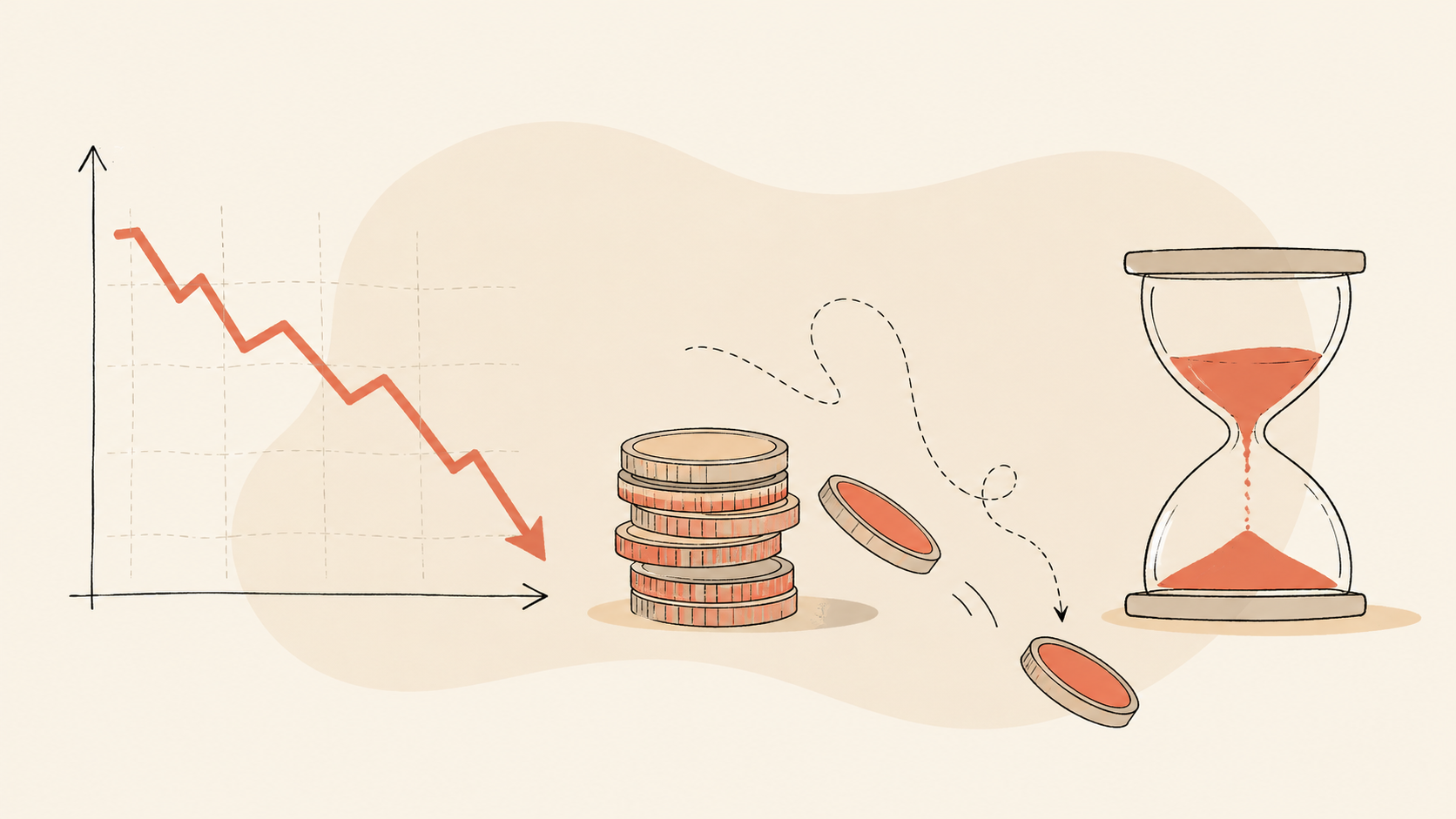
For most of 2023 and 2024, "wait and see" was a defensible strategy on AI. The technology was real but the practical applications were thin, the failure rate was high, and the cost of being wrong was meaningful. That window has closed. In 2026, waiting on AI is no longer cost-free — it's an active business choice with measurable consequences. This piece walks through what those consequences actually are, with numbers and examples, so you can decide whether your "we'll deploy AI when it matures" position is still defensible. For most businesses, it isn't.
The four real costs of inaction
There are four ways waiting actually hurts you in 2026:
- Captured revenue you're leaving on the floor. Leads, calls, conversions you'd recover with basic AI deployment.
- Productivity gap vs. your competitors. Hours of work per output that the rest of your industry is no longer doing manually.
- Customer experience drift. Expectations are shifting; what felt acceptable in 2023 looks slow and outdated in 2026.
- Talent risk. The best people in your industry are gravitating to AI-forward employers.
Let's quantify each.
Cost #1: Captured revenue
This is the easiest to measure and the largest in dollar terms for most businesses.
The pattern that catches almost every service business off guard: 30–60% of inbound leads come outside business hours, on weekends, or during periods when staff can't respond inside 30 minutes. Inquiries that don't get a response in the first hour convert at a small fraction of the rate of inquiries that get an instant response. Multiple industry studies on lead response time, including the well-cited Harvard Business Review piece on the short-life of online sales leads, have documented the dropoff repeatedly.
What that costs varies by business but anchors quickly:
- Dental practice doing 40 new-patient inquiries per month, missing 20 of them, at a $2,000 average LTV with a 30% conversion-on-recovery rate: ~$12,000/month of captured revenue gap = $144,000/year.
- Home services contractor doing 60 inquiries per month, missing 25 of them, at a $1,200 average job value with a 40% conversion-on-recovery rate: ~$12,000/month = $144,000/year.
- Law firm doing 50 inquiries per month, missing 15 of them, at a $15,000 average case value with a 10% conversion-on-recovery rate: ~$22,500/month = $270,000/year.
- E-commerce store doing 5,000 cart abandons per month, with 8% recoverable through proactive AI chat at $80 AOV: $32,000/month = $384,000/year.
These are real numbers for real businesses, and they accumulate every month the AI isn't deployed. For deeper math on these specific cases, see AI for dental practices, AI for home services, AI for law firms, and AI chatbots for e-commerce.
Cost #2: Productivity gap
This is harder to feel month-to-month but enormous over time.
By 2026, AI-augmented teams in many functions are 30–60% more productive than non-AI-augmented teams doing the same work. The categories where the gap is widest:
- Customer support response time. AI-augmented support teams resolve faster, deflect routine queries, and free human reps for complex work.
- Sales prospecting and follow-up. AI-augmented sales reps work 2–3x more prospects with personalization that previously required junior SDR labor.
- Marketing content production. AI-augmented content teams produce 3–5x more drafts (which still require human editing, but the draft-to-publish workflow is dramatically faster).
- Operations and back-office. Invoice processing, data entry, document review — categories where AI augmentation is removing entire job categories of tedious work.
- Engineering. AI-augmented developers ship features 20–40% faster across most categories of work.
If your competitors operate at 130–160% of your productivity per employee, the cost shows up in every quarterly comparison: their margins are better, their growth is faster, their ability to invest in differentiation is higher. After 18 months, that gap is structural.
Cost #3: Customer experience drift
Customer expectations have shifted. The new baseline in 2026:
- 24/7 availability on at least one inbound channel
- Response to web inquiries within 60 seconds
- Phone calls answered without lengthy hold queues
- Personalized recommendations based on history
- Multilingual support where customer base warrants it
- Mobile-first, conversational interfaces
Businesses that haven't met this baseline aren't being judged neutrally — they're being judged against AI-enabled competitors who set the new bar. Reviews, NPS scores, and conversion rates reflect the gap. Often this shows up before the business notices, because the customers who left for AI-enabled competitors don't usually tell you why.
A representative pattern: a regional law firm we'd talked to in 2024 was happy with their position. By late 2025, their qualified-lead conversion rate had dropped 22% year-over-year. Investigation revealed prospects increasingly trying after-hours and weekend channels — and finding those channels unstaffed. The leads went to competitors with chatbot intake. By the time the firm noticed the trend, they'd lost two full quarters of pipeline.
This pattern is now common across many service categories.
Cost #4: Talent
The people you want to keep — the best engineers, the best ops leads, the best customer-facing staff — increasingly want to work for AI-forward companies. They're being asked at interviews how their employer thinks about AI. "We're still figuring it out" is no longer a neutral answer. It signals slow-moving leadership, fewer growth opportunities, and a future spent doing manual work that competitors have automated away.
The cost shows up in:
- Higher recruiting costs for senior talent
- Higher attrition in technical and analytical roles
- Reduced ability to attract top-tier talent for AI-adjacent positions
- Pipeline gaps as junior talent gravitates toward companies that will train them in AI tooling
This is the hardest cost to measure but the most strategically damaging. Companies lose decade-long compounding advantages when they lose their best people.
The "but the technology will be cheaper next year" argument
A common pushback: AI is getting cheaper every year, and the systems will be better. Why deploy now when 2027's tools will be more capable for less money?
This argument has two flaws.
First, the captured-revenue cost above is happening every month. Waiting 12 months means losing 12 months of recovery. For most businesses, that's significantly more than the deployment cost itself. You don't actually save money by waiting — you just shift it from one budget line (AI implementation) to another (lost revenue).
Second, the technology being cheaper doesn't help if your competitors have spent 12 months learning to use it. Operational AI capability is built through deployment, iteration, and team experience. The agency that starts deploying in May 2026 has a different capability in May 2027 than the one that starts deploying in May 2027 has on day one. So does the in-house team.
The right framing isn't "wait for cheaper tools." It's "deploy now, with the expectation of cheaper tools improving the economics over time."
The "but our team isn't ready" argument
A real concern, and a fixable one. Most teams aren't ready because they haven't had the chance to learn. The fix isn't waiting until they're ready — it's pairing a deployment with structured learning.
Practical sequence:
- Start with one focused use case
- Choose an agency that pairs delivery with team training
- Build an internal "AI champion" role (often a part-time allocation for an existing employee)
- Run a 90-day pilot with clear metrics
- Expand based on what worked
For sequencing ideas, see 15 AI automations worth automating first and the AI implementation timeline.
The "AI is overhyped" argument
This is partly correct and entirely irrelevant. Yes, parts of the AI conversation are overhyped. Autonomous AGI replacing all knowledge work isn't here. Self-driving sales teams aren't here. Magical bots that need no oversight aren't here.
But:
- After-hours lead capture is real and pays back in months
- Voice agents handling appointment booking are real and pay back in months
- Document review acceleration for law and accounting is real
- Multilingual customer support is real
- Sales prospecting acceleration is real
Hype doesn't mean fake. The bar is whether specific use cases pay back in your business. For most businesses, several do.
What inaction actually costs over 24 months
Putting realistic numbers on a representative mid-size service business — say, a dental practice group, a home services contractor, a regional law firm:
| Cost category | 24-month range |
|---|---|
| Captured revenue gap (missed inbound) | $150,000–$500,000+ |
| Productivity gap (vs. AI-augmented competitors) | $50,000–$200,000 |
| Customer experience drift (lost retention) | $25,000–$150,000 |
| Talent risk (recruiting + attrition cost) | $20,000–$100,000 |
| Total 24-month cost of inaction | $245,000–$950,000+ |
Compare this to an actual deployment:
- Setup: $25,000–$60,000
- Monthly all-in: $2,000–$5,000 × 24 = $48,000–$120,000
- Total 24-month deployment cost: $73,000–$180,000
The math isn't close. For more on what deployment actually costs, see what AI chatbots actually cost in 2026 and AI agency vs. AI platform.
What to do this week
If this argument lands, the right next steps are deliberately small:
- Audit your missed inbound. Pull the last 90 days of phone records, web inquiries, and chat sessions. Count the ones that didn't get handled within an hour.
- Estimate the captured-revenue gap. Average customer value × your recovery probability × number of missed inquiries.
- Identify the single highest-ROI deployment. Usually inbound chatbot or voice agent. Sometimes internal automation.
- Get one scoped quote. Specific use case, specific volume, specific outcome metrics. Compare against the captured-revenue math.
- Decide.
This shouldn't take more than two weeks. Don't drag it into a six-month strategic review.
What we deploy at SpeedX Marketing
We focus on high-ROI, fast-to-deploy AI automations for service and e-commerce businesses across the US, UK, and globally. Setup ranges $10,000–$60,000 depending on scope. Most engagements show measurable returns within 3–6 months.
For service overviews, browse our AI automation services in New York, AI chatbot development services in Los Angeles, or AI calling agent development services in San Francisco.
Free cost-of-inaction assessment
If you want a real estimate of what AI inaction is costing your specific business — scoped to your industry, volume, and customer base — book a free 30-minute call. We'll model the missed-revenue math against typical deployment costs and tell you whether moving now makes sense. Message us on WhatsApp, email info@speedxmarketing.com, or reach out through our contact page.