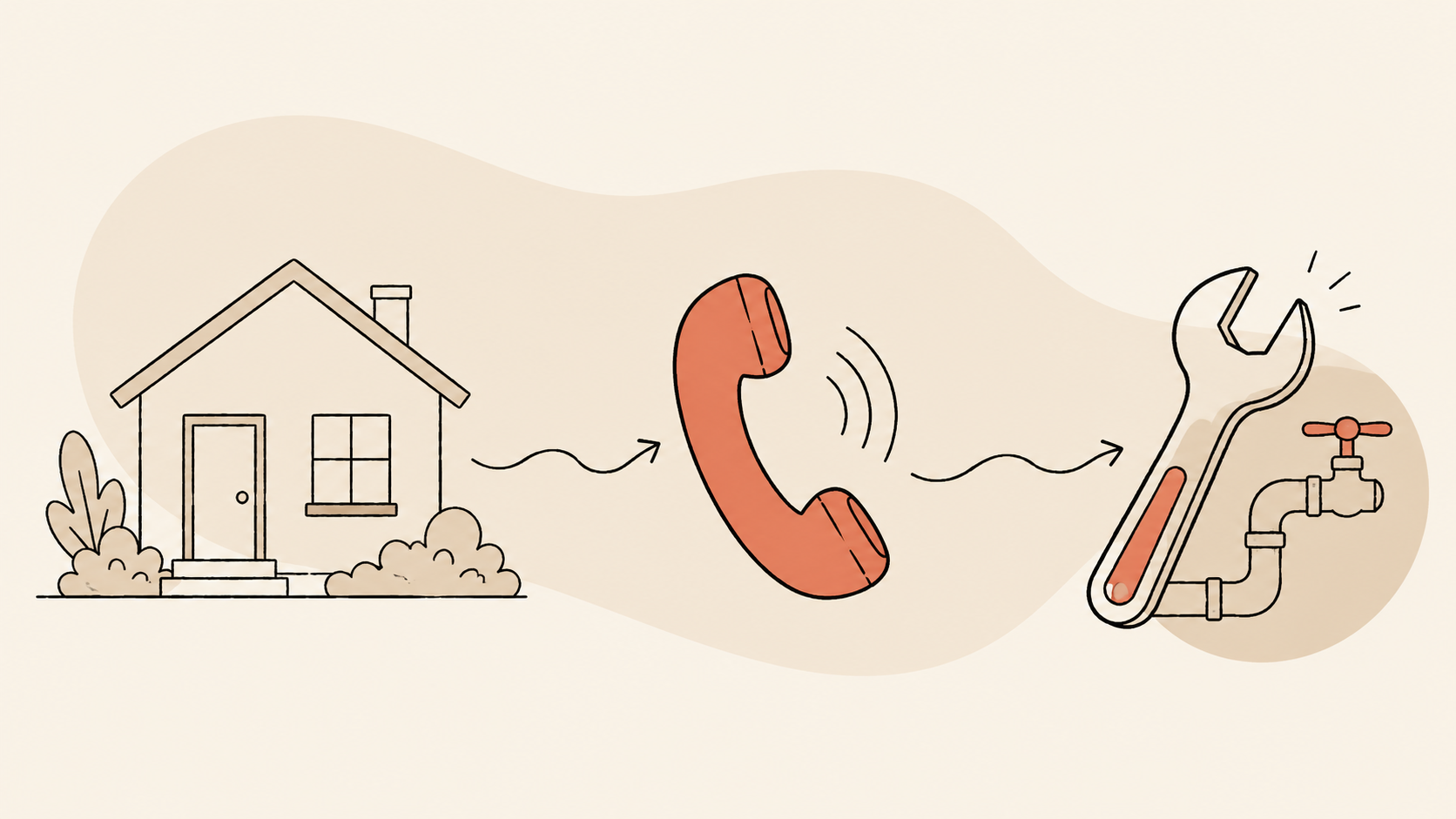
Home service businesses live and die by the phone. When an HVAC system fails on the hottest day of the year, when a pipe bursts at midnight, when a breaker trips during a Zoom call — the homeowner picks up the phone, calls three companies, and books with whoever answers first. If your team is already on a job, in a truck, or off the clock, you lose. Modern AI voice agents close that gap. Here's what AI calling actually looks like in home services, where it pays off, and how to deploy it without overengineering.
What an AI voice agent does for a home service business
A well-built AI voice agent picks up your inbound calls, qualifies the lead, books the appointment in your dispatch system, and texts a confirmation — all in under two minutes. It also runs outbound campaigns: recall reminders, post-service follow-ups, review requests, and lapsed-customer reactivation. It speaks naturally, sounds like your company, and integrates with the dispatch and CRM tools you already use.
The agent isn't a replacement for your CSRs. It handles the routine calls that drain your team's capacity — after-hours bookings, simple service inquiries, confirmation calls, follow-ups — and hands off cleanly when something is complex, urgent, or requires human judgment.
Use case 1: After-hours inbound
For most home service businesses, 25–40% of inbound calls happen outside business hours: nights, weekends, and during peak season when daytime lines are saturated. Most of those calls go to voicemail, an answering service, or a competitor. An AI voice agent picks up on the first ring at 11 p.m. on a Saturday, books the next-day emergency slot, and sends a confirmation text. The next morning, your team walks in with a fuller schedule and zero missed opportunities.
A single recovered after-hours booking on an HVAC system replacement is worth thousands. The agent typically pays for itself in the first 30 days from after-hours alone.
Use case 2: Outbound recall and seasonal campaigns
Every HVAC company has a "spring tune-up" list. Every plumbing company has a "annual water heater inspection" reminder. Most companies don't work those lists consistently because dialing 800 customers manually is a soul-crushing job. An outbound AI agent works the list during off-peak hours, books the willing customers, leaves personalized voicemails for the unreachable ones, and sends SMS follow-ups. Conversion rates of 15–25% on cold recall lists are normal.
Use case 3: Lapsed customer reactivation
Customers who haven't called in 18+ months are a goldmine — they liked you enough to use you the first time. An AI outbound agent can work this list with a "we wanted to check in" angle, offer a tune-up special, and book the willing customers. Most home service businesses find this generates more revenue per dollar spent than any cold-lead channel.
Use case 4: Appointment confirmation and reschedule
The agent calls or texts the day before each appointment, confirms attendance, and — if the customer needs to reschedule — offers an immediate alternative slot pulled from your dispatch system. This drops no-show rates significantly and gives your dispatch team back the time spent chasing confirmations.
Use case 5: Post-service review requests
After every completed job, the agent reaches out by SMS (or call, depending on the channel the customer prefers) and asks for a review. For satisfied customers, it provides a direct link to your Google Business Profile, Yelp, or Facebook review form. For unhappy customers, it routes to your manager for service recovery before the customer leaves a public negative review. This is the cleanest "more reviews + fewer 1-stars" workflow we deploy.
Use case 6: Dispatch and routing assistance
A voice agent can collect the address, type of issue, urgency, and any special considerations (e.g., "the dog will be in the yard"), then write this directly into your dispatch system. Pre-loaded with customer history, the dispatcher sees a clean ticket with all the right context — instead of a hand-scribbled note on a Post-it.
Integration with your field service software
Voice agents are only useful if they write into your dispatch and CRM. The major home services platforms we integrate with:
- ServiceTitan — full API, well-documented, the most common platform for mid-to-large HVAC/plumbing/electrical
- Housecall Pro — strong API, easy integration
- Jobber — full API, common for smaller residential service teams
- FieldEdge, mHelpDesk, Service Fusion — well-supported integrations
- Custom or legacy systems — usually require a middleware layer; we build them where needed
The agent reads availability from your dispatch board, writes appointments back, and updates customer records in real time. It also pulls from customer history — so a returning customer doesn't have to repeat their address or system details.
What about compliance?
Two things to watch:
- TCPA compliance for outbound campaigns: Any outbound automated calling to mobile numbers requires express written consent under the FCC's TCPA rules. Make sure your customer agreement includes consent language and that your dispatch system tracks consent status per customer.
- Call recording disclosure: Most states require disclosure when calls are recorded. The agent should include this disclosure naturally in the opening greeting.
We bake these into the deployment from day one.
What it actually costs
Setup for a home services voice AI deployment typically runs in the low-to-mid five figures depending on scope (channels, integrations, scripting complexity), with ongoing usage costs in the range of $0.10–$0.30 per minute of call time. For a typical 50–200 truck home service operation, the ROI math is usually:
- Setup: $10,000–$30,000 depending on scope
- Ongoing monthly usage: $500–$3,000 depending on call volume
- Typical payback period: 30–90 days from a combination of captured after-hours bookings, faster qualification, and outbound recall conversions
For pricing detail on AI deployments more broadly, see our breakdown of what AI calling agents actually cost in 2026 and the comparison of inbound vs. outbound AI calling agents.
What to deploy first
If you're starting cold, deploy after-hours inbound first. It's the fastest path to revenue you can see in your dispatch board within a week. Add review collection in month two — it's low-friction and compounds your local SEO. Add outbound recall in month three once you're confident in the agent's voice and scripting.
What to skip on day one: complex IVR replacement, anything involving billing disputes (humans only), and outbound cold lead lists (the conversion rates aren't there yet, and the brand risk is high).
For the broader voice AI service, browse our AI calling agent development services in New York.
Free voice AI demo for your service business
If you want to hear how an AI voice agent would handle a typical inbound call for your business — recorded in your company's voice, with your scripts — we'll set up a free 30-minute demo. No commitment, no payment. Message us on WhatsApp, email info@speedxmarketing.com, or reach out through our contact page.