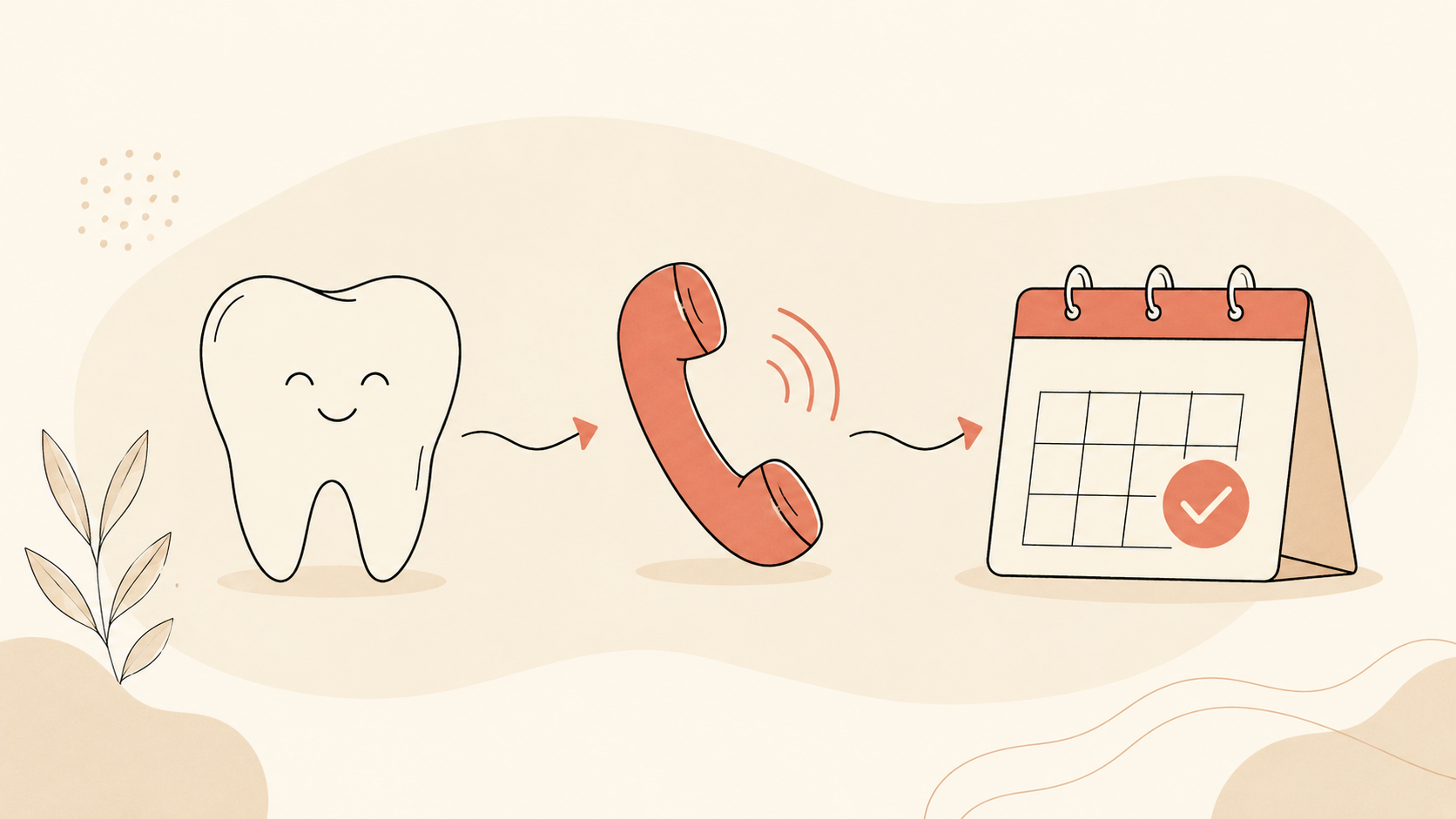
Dental practices have a phone problem. The chair is empty if the phone doesn't get answered, the recall list doesn't get worked, or the patient hangs up on the second hold message. Front desk teams are stretched, after-hours calls go to voicemail, and most "after-hours services" are answering services that just take a message. Modern AI voice agents fix the bottleneck without replacing your team — they handle the inbound and outbound calls that your front desk doesn't have time for, and they hand off cleanly when a human is needed.
Here's what dental-specific AI voice deployment actually looks like in 2026.
What an AI calling agent does in a dental practice
A well-built AI voice agent for dental can:
- Answer inbound calls in your practice's voice, with your scripting
- Book, reschedule, and confirm appointments directly in your PMS (Dentrix, Eaglesoft, Open Dental, Curve, Denticon, etc.)
- Run insurance pre-verification questions
- Handle recall outreach (the six-month hygiene reminder calls that nobody loves making)
- Send appointment reminders by SMS and follow up if there's no response
- Transfer to a human for anything outside its scope — emergency calls, complex cases, billing disputes
The agent doesn't replace your front desk. It clears the bottom 80% of routine call volume so your team can focus on the patients sitting in the waiting room.
Use case 1: After-hours and overflow
Most practices get 15–30% of their bookings outside business hours — evenings, weekends, lunch breaks when the front desk is at lunch too. Those calls usually go to voicemail, and a significant share never get returned. An AI calling agent picks up at 9 p.m. on a Tuesday, books the appointment, sends a confirmation text, and you walk in Wednesday morning to a fuller schedule. The math is straightforward: if your practice misses three bookings a week at $400 each, that's $62,400 of recovered revenue annually.
Use case 2: Recall outreach
The patients who haven't been in for 9+ months are some of the easiest revenue you'll ever recover, but no one wants to spend three hours dialing through them. An AI outbound agent works the list during off-hours, books appointments for the ones who pick up, and leaves a personalized voicemail for the ones who don't. Built right, this can rebook 15–25% of inactive patients per cycle.
Use case 3: Insurance pre-checks
For new patient calls, the agent can collect insurance information, verify in-network status with the carrier (where API access exists), and flag any pre-authorization needs before the appointment. This shifts a 10-minute front-desk task to a 2-minute automated workflow.
Use case 4: Appointment confirmations and cancellation recovery
The agent calls or texts the day before each appointment, confirms attendance, and — if the patient needs to cancel — offers an immediate reschedule and pulls the next person off the wait list. Most practices see no-show rates drop by 20–40% within the first quarter.
What about HIPAA?
This is the question every dentist asks first, and rightly so. The short answer: HIPAA-compliant deployments are possible, but they require care.
- The voice AI vendor must sign a BAA (Business Associate Agreement) before any PHI flows through their system.
- Call recordings and transcripts must be stored under HIPAA-compliant infrastructure — encrypted at rest, encrypted in transit, access-controlled, with audit logs.
- Limit what the agent collects. Only collect the minimum necessary information. Insurance verification doesn't need to include diagnosis details unless absolutely required.
- Train the agent on your specific scripts — including how to handle the moment a caller starts sharing more than they should.
The U.S. Department of Health and Human Services publishes official HIPAA compliance guidance for business associates that's worth reading before signing any vendor agreement. We build dental AI deployments with these constraints in mind from day one.
Integration with your PMS
A voice agent isn't useful if it can't write into your practice management system. The major dental PMS platforms have varying levels of integration support:
- Dentrix — API integrations available; works well with most modern voice agents
- Open Dental — open-source friendly, easy to integrate
- Curve, Denticon, Carestream — cloud-based platforms with well-documented APIs
- Eaglesoft — older system; integration often requires middleware
If your PMS is older or doesn't have a clean API, we usually build a thin middleware layer that writes appointments via the front-desk-facing interface. It's less elegant than a direct integration but it works reliably.
What it actually costs
Setup for a dental AI calling agent typically runs in the low-to-mid five figures depending on scope, with ongoing usage costs in the range of $0.10–$0.30 per minute of call time. Most practices break even within the first 2–4 months on captured after-hours bookings alone, then continue to gain ROI from recall, no-show recovery, and front-desk time freed up.
Read more about pricing breakdowns and bundled vs. BYO API costs if you want the technical detail.
What to build first
If you're starting cold, deploy after-hours coverage first. It's the lowest-friction win and you'll see the impact in the schedule within a week. Add recall outreach in month two and confirmation/cancellation in month three. Insurance pre-checks last — they require the most integration work.
For a deeper look at how voice AI works for service businesses generally, see our piece on the real ROI of an AI calling agent, or browse our AI calling agent development services in New York.
Free voice AI demo + use-case mapping
If you want to hear what an AI voice agent for your practice would actually sound like — and which of these use cases would pay off fastest — we'll set up a free 30-minute demo call. No commitment, no payment. We'll record a sample call using your practice's name and scripts so you can hear it in your own voice. Message us on WhatsApp, email info@speedxmarketing.com, or reach out through our contact page.