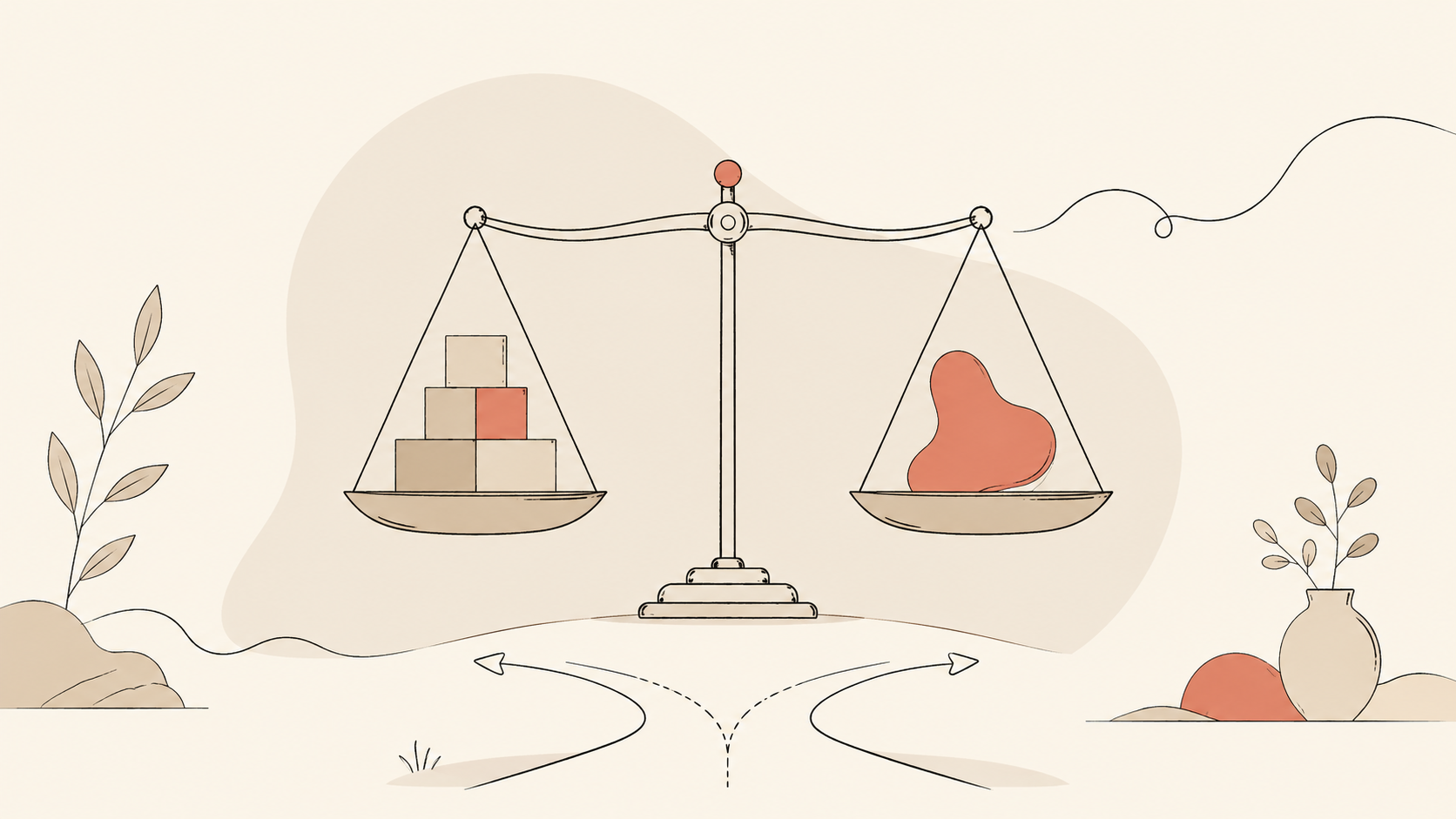
Walk into the AI buying decision in 2026 and you're immediately facing two very different sales pitches. On one side: SaaS platforms promising "AI chatbots in 10 minutes" with monthly subscriptions starting under $100. On the other: AI agencies pitching custom builds, six-figure budgets, and 90-day implementation timelines. Both sound right depending on who's talking. Both can be wrong for your business. This guide walks through what each model actually delivers — including the things the sales decks skip — so you pick the one that fits your situation instead of the one with the louder pitch.
The short version
If you need a focused chatbot, a basic automation, or a single-channel deployment, and you have someone internal who can babysit it, a platform is usually the right call. If you need anything multi-system, multi-channel, deeply integrated, or strategically differentiated, an agency is almost always cheaper over 18–24 months — even though it looks more expensive on day one.
That's the headline. The rest of this piece explains why, and shows you the exact break-even points where the math flips.
What an AI platform actually gives you
AI platforms are SaaS products. You sign up, configure inside a UI, and pay a monthly fee. Names you'll see: Intercom Fin, Drift, Tidio, ManyChat, Voiceflow, Chatbase, Botpress, Landbot, Zapier AI, Make with LLM nodes, plus dozens of category-specific tools.
What you get:
- A point-and-click interface for building flows and prompts
- Pre-built integrations with common SaaS (Shopify, HubSpot, Salesforce, etc.)
- A managed underlying LLM (you don't choose the model — they do)
- Hosting, monitoring, basic analytics, basic security
- Usage-based or seat-based pricing
What you're really buying: speed, simplicity, and someone else's infrastructure. The trade-off is constraint. The platform decides what you can and can't build, what models you can call, what data leaves their walls, and how integrations behave.
What an AI agency actually gives you
An AI agency is people. You scope a project, sign a statement of work, and the agency builds a custom solution that lives in your infrastructure (or runs on their managed stack). Project fees plus ongoing retainer.
What you get:
- A solution designed around your specific workflows, not someone else's template
- Choice of LLM (GPT, Claude, Gemini, open-source) and the freedom to switch
- Choice of where data lives (your cloud, their cloud, on-prem)
- Custom integrations with internal systems platforms don't support
- Ownership of the code and configuration (or licensed use, depending on contract)
- A team that learns your business and improves the system over time
What you're really buying: control, depth, and a strategic moat. The trade-off is investment. Agencies cost more upfront and require you to manage the relationship.
The cost comparison most articles get wrong
Platform pricing pages quote a low monthly fee. Agency proposals quote a large project fee. Most buyers compare those two numbers, decide the platform is cheaper, and only later discover the platform's real total cost. Here's the honest framing.
A platform's real cost includes:
- Monthly subscription (often tiered by volume or features)
- Per-conversation or per-resolution fees (often invisible until you hit your limit)
- Add-on fees for additional channels (WhatsApp, SMS, Messenger often charged separately)
- API/LLM usage fees if not bundled
- Internal staff time configuring, maintaining, and troubleshooting
- Migration costs when you outgrow the platform
An agency's real cost includes:
- Project fee (one-time)
- Monthly retainer or maintenance fee
- API/LLM usage (typically passed through at vendor cost)
- Internal staff time on the relationship
When you add everything up, the picture changes:
| Scenario | Platform total (24 mo) | Agency total (24 mo) |
|---|---|---|
| Small business, single-channel FAQ bot, ~500 convos/mo | $4,800–$12,000 | $14,000–$25,000 |
| Mid-size, multi-channel, CRM integration, ~3,000 convos/mo | $36,000–$72,000 | $30,000–$60,000 |
| E-commerce, cart recovery, multi-channel, ~10,000 convos/mo | $96,000–$240,000 | $50,000–$120,000 |
| Enterprise, complex multi-system, ~50,000 convos/mo | $400,000+ | $150,000–$400,000 |
The break-even almost always sits around the 2,000–3,000 conversations/month mark. Below that, platforms win on cost. Above that, agency builds pay for themselves quickly. For a deeper cost breakdown across both models, see what AI chatbots actually cost in 2026.
Speed: who actually ships faster?
Platforms ship faster on day one. You can have a basic chatbot live in a single afternoon. Agencies typically take 4–12 weeks for a first production deployment.
But "shipping" and "shipping something that actually works for your business" are two different bars. Most platform deployments hit a wall within 30–60 days: the bot is missing context, the integrations don't quite fit, the conversation design needs polish, and someone internally has to spend 5–10 hours a week wrestling with it. An agency engagement front-loads that work — and produces a system that runs without internal wrestling once it's live.
If your bar is "ship something this week," go platform. If your bar is "have a system in production that doesn't eat my team's time three months from now," agency.
Customization: where platforms break
Every platform makes assumptions. Some are fine. Some are deal-breakers depending on your business. Common breakage points:
- Custom integrations. If your CRM is a homegrown system, a regional ERP, or a niche SaaS, the platform's pre-built integrations won't help. You'll need to build the integration yourself anyway — and platforms charge to expose the APIs you need to do that.
- Workflow logic. Platforms support "if X, do Y" branching. They struggle with multi-step agentic workflows (research → analyze → act → confirm), long-context reasoning, or custom retrieval over your internal docs.
- Brand voice. Most platforms make you choose between their default voice or generic prompt-based tuning. Real brand-voice training requires examples, evaluation, and iteration — usually beyond what a platform UI exposes.
- Compliance. HIPAA, SOC 2, GDPR, and industry-specific compliance is harder on platforms. Some support it at higher tiers; many don't support it at all. For healthcare specifically, see our AI for healthcare practices and HIPAA guide.
- Multi-language brand work. Platforms handle basic translation; they struggle with culturally localized voice in 5+ languages. For more on this, see multilingual AI chatbots.
If any of those break your use case, the platform isn't actually saving you money — it's just making the eventual agency build more expensive because you've wasted time on a sunk-cost detour.
Ownership and lock-in
This is the part platform sales decks never highlight. When you build on a platform:
- Your training data lives in their system
- Your conversation history lives in their system
- Your integrations are configured in their system
- Your custom logic is locked to their UI
When you switch platforms, you start from zero. Some platforms charge to export your data. Some make it impossible to export the configuration. The migration cost is real and shows up only when you need to leave.
When you build with an agency:
- You own the code (or have licensed use)
- You own the training data
- You own the integrations
- You can move the system to a new vendor without redoing the work
Whether that ownership matters depends on whether you see your AI capability as core infrastructure or as a vendor service. For most growing businesses, AI is becoming core infrastructure — and the lock-in cost compounds every year.
Strategic differentiation
If your competitors are all on Intercom Fin, your chatbot looks like their chatbot. Same answers, same flow, same limitations. That's fine for utility — and a problem for anything you want to compete on.
Agencies build for differentiation. A custom AI app that understands your specific product catalog, customer journey, and brand voice doesn't look like anyone else's. For categories where the AI experience is itself the product (luxury e-commerce, premium services, complex B2B sales), differentiation matters.
For the deeper trade-off, see custom AI app vs. SaaS for SMBs.
When a platform is clearly the right choice
Be honest about which side you're on. Pick a platform when:
- Your use case is well-defined and standard (basic FAQ, lead capture, appointment booking on a single channel)
- Volume is low enough that platform pricing stays cheap
- You don't need deep integrations with non-standard systems
- You have someone internal who can own the configuration
- You aren't building a differentiated AI experience as part of your product
- You want to ship something this week, not this quarter
When an agency is clearly the right choice
Pick an agency when:
- Your AI use case is multi-channel or multi-system
- You need custom integrations the platforms don't support
- You're in a regulated industry (healthcare, legal, financial services)
- Volume is high enough that platform per-conversation fees stack up
- Your brand voice or product experience is a real differentiator
- You want to own the system, not rent it
- You don't have an internal team to manage platform configuration
The hybrid path
It's not always either-or. Many businesses run a platform for one use case (FAQ on the marketing site) and an agency build for another (custom internal agent integrated with their warehouse system). The categories aren't competitors — they're tools for different jobs.
What you want to avoid is the unintentional hybrid: platform everywhere, agency-built patches on top, no one clear about ownership. That setup gets expensive fast and falls apart on the next platform pricing change.
What we'd ask before deciding
If you're stuck on this decision, ask yourself:
- What's the volume? Below 2,000 conversations/month, lean platform. Above that, lean agency.
- What's the integration list? If your integrations are vanilla SaaS, platform works. If they include anything custom or regulated, agency.
- What's the time horizon? Building for the next 12 months? Either works. Building for the next 5 years? Agency, because lock-in compounds.
- What's the differentiation story? If you're competing on AI experience, agency. If AI is just utility, platform.
- Who owns it internally? If you have a strong internal AI lead, either works. If not, agency provides the team you don't have.
If you've answered those five questions and still aren't sure, talk to both. Reputable agencies will tell you when a platform is the right call for your situation — we do this multiple times a month.
How SpeedX Marketing fits in
Our team builds custom AI chatbots, calling agents, automations, and applications across the US, UK, and globally. We also have clients running platforms where that's the right answer. Our approach is to scope honestly: if a $79/month platform handles your use case, we'll tell you. If it doesn't, we'll show you exactly what a custom build costs and what it would do that the platform can't.
For service overviews, browse our AI chatbot development services in New York, AI automation services in New York, or AI application development services in New York.
Free automation opportunity assessment
If you'd like an honest read on whether you should buy a platform or build with an agency, book a free 30-minute call. We'll review your use case, scope, volume, and integration list — and tell you what to do. No deck, no pressure. Message us on WhatsApp, email info@speedxmarketing.com, or reach out through our contact page.