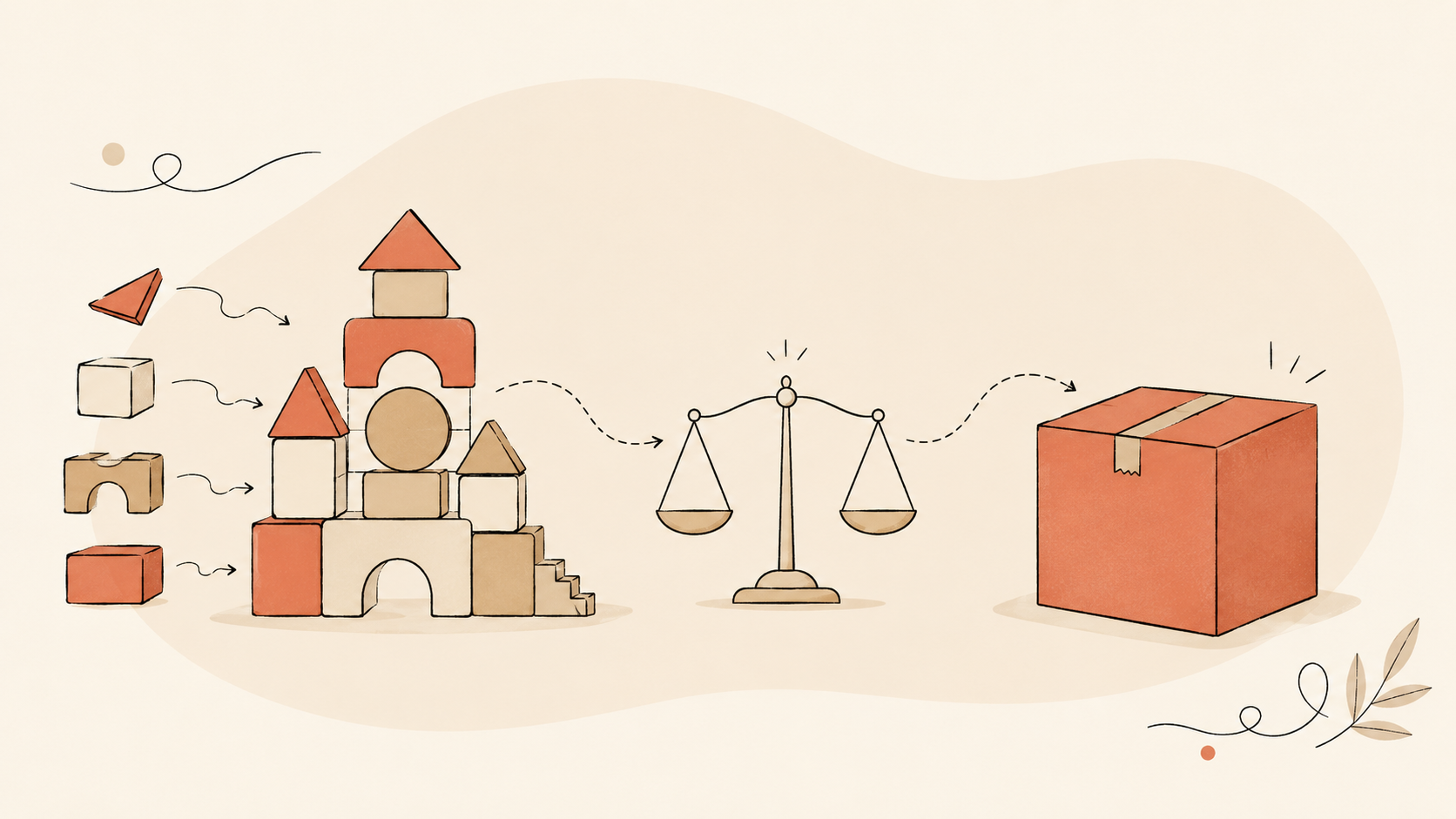
The "build vs. buy" question used to be reserved for enterprises with seven-figure technology budgets. AI flipped that. In 2026, the cost of building a custom AI application has dropped enough that small and mid-size businesses are seriously asking whether to subscribe to SaaS or commission a custom build. The answer isn't universal — but it isn't random either. Specific patterns make one or the other clearly right. This guide walks through both paths with cost, control, and break-even math, so you can decide without relying on either the SaaS marketing department or the agency sales deck.
The two paths, in plain terms
SaaS path. Subscribe to a software product that has AI built in. Examples: HubSpot's AI suite, Salesforce Einstein, Intercom Fin, Notion AI, Jasper, Glean, Synthesia, dozens more. You configure inside their UI, pay monthly, and use it.
Custom AI app path. Commission a software application built specifically for your business. Could be a customer-facing product, an internal tool, or a workflow application. Built on top of LLMs (OpenAI, Anthropic, Google, open-source) plus a vector database, plus integrations specific to your stack.
The trade-off is essentially the same as 30 years of "buy vs. build" debates: SaaS is faster and cheaper to start; custom is more control and (eventually) cheaper at scale.
When SaaS is clearly the right answer for an SMB
The cases where you should not be building custom:
- The use case is standard. CRM, email marketing, accounting, support ticketing, content drafting. The SaaS market is mature, the products are excellent, and you have nothing to gain by building.
- You don't have an internal technical lead. Custom apps need someone internal who can manage the relationship with the agency, evaluate output, and own the product roadmap. Without that, the custom path drifts.
- Volume is low. SaaS pricing is per-seat or usage-based, and at low volumes you'd be paying enterprise pricing for a custom build to handle work that costs you $200/month on SaaS.
- You're early in your business journey. First two years of a business is the wrong time to invest in custom infrastructure. Use SaaS, learn what your workflows actually look like, then build only what proves to be strategic.
- The SaaS already handles 80%+ of what you need. Custom builds make sense when the gap is real. If it isn't, you're paying to redo what's already done.
For most SMBs, most AI use cases fall in this bucket. The default should be SaaS unless something specific argues against.
When a custom AI app is clearly the right answer
The cases where SaaS isn't enough:
- Your differentiation depends on AI experience. If your customers are choosing between you and competitors partly based on the AI features your product offers, those features need to be yours, not your vendor's.
- The use case is non-standard. SaaS products are built for the average customer. If your industry, workflow, or product is unusual, the AI features in standard SaaS will feel generic and miss the point.
- Integration depth matters. Custom AI apps integrate deeply with your existing data — internal product catalogs, customer history, proprietary knowledge bases. SaaS rarely integrates this deeply, and where it does, the integrations are limited by what the SaaS vendor supports.
- Cost at scale. SaaS pricing compounds. A custom build's marginal cost approaches zero as usage scales. The break-even varies by category but typically hits between $2,000/month and $10,000/month of equivalent SaaS spend.
- Data ownership is a competitive concern. If your customer data, transaction patterns, or product information is a strategic asset, having it pumped into a SaaS vendor's models is a real concern.
- The SaaS market doesn't have what you need. Some categories — particularly industry-specific or workflow-specific — don't have mature SaaS yet. Custom is the only option.
For most SMBs, one or two specific use cases land in this bucket — usually a customer-facing AI experience, a deep internal automation, or an operations-critical workflow. Custom builds make sense for those.
A practical decision framework
For each candidate AI use case, ask:
- Is the use case standard or specific? Standard → SaaS. Specific to your business → consider custom.
- Is the AI feature strategic or utility? Strategic → consider custom. Utility → SaaS.
- What's the monthly equivalent SaaS spend? Under $1,500 → SaaS. $1,500–$5,000 → analyze. Over $5,000 → consider custom.
- Do you have an internal technical lead? No → SaaS. Yes → either path open.
- Do you need deep integration with proprietary data? No → SaaS. Yes → consider custom.
- What's the time horizon? Under 18 months → SaaS. Over 18 months → custom math improves.
A consistent "yes, custom" pattern across these means custom is probably right. A mixed pattern usually points back to SaaS for now.
The cost comparison
For a representative use case — say, an AI-powered internal knowledge assistant for a 50-person services company:
SaaS path:
- Subscription (e.g., Glean, Notion AI, or similar enterprise tier): $20–$50/user/month × 50 users = $1,000–$2,500/month
- Setup/onboarding: $1,000–$5,000
- 24-month cost: $25,000–$65,000
Custom AI app path:
- Setup: $30,000–$80,000
- Monthly hosting + API + maintenance: $1,500–$5,000
- 24-month cost: $66,000–$200,000
At first glance, SaaS wins. But the comparison isn't apples-to-apples:
- The custom app does what the SaaS does plus integrations specific to your business (proprietary product catalog, internal SOPs, deal history, regional pricing logic).
- The custom app's marginal cost flattens. SaaS scales linearly with users; custom scales with infrastructure (much shallower curve).
- The custom app generates strategic IP. SaaS doesn't.
At 50 users and standard use cases, SaaS wins. At 200 users, deep integrations, and strategic differentiation, custom usually wins. The break-even point varies by category.
For broader cost framing, see what AI chatbots actually cost in 2026 and AI agency vs. AI platform.
The "best of both" hybrid path
Most successful SMBs end up with a hybrid:
- SaaS for everything standard (CRM, accounting, project management, basic AI features)
- Custom for one or two strategic, differentiation-touching capabilities
- Integrated together via APIs
This pattern minimizes total cost and maximizes the value of custom investment. The mistake is letting either side metastasize — letting SaaS sprawl into shadow IT, or letting custom development eat your entire technology budget for marginal gain.
What custom AI apps look like in practice
A few real examples (sanitized) of custom AI apps we've built for SMBs:
- Specialty e-commerce — product recommendation engine. Trained on the company's product catalog, historical sales patterns, and customer segments. Lifted recommendation-driven revenue by ~28% over the baseline Shopify recommendations.
- Professional services — proposal generator. Takes scope inputs, historical pricing data, and prior similar projects to draft a tailored proposal. Replaced 3–5 hours of partner time per proposal.
- B2B distributor — quote engine. Integrated with internal pricing, inventory, and customer tier data. Generated quotes from sales reps' rough inputs in under 30 seconds.
- Healthcare practice — intake and triage app. Patient-facing intake that integrates with EMR, schedules into the practice management system, and routes urgent cases. HIPAA-compliant architecture throughout.
- Real estate brokerage — buyer-matching assistant. Internal tool that surfaces appropriate listings for buyer leads based on stated preferences, viewing history, and inferred priorities.
Note the pattern: each one solves a specific, deep problem that wasn't going to be solved by generic SaaS. None of them are "an AI chatbot." All of them deliver clear ROI.
What you actually own with a custom AI app
This matters more than buyers realize. A well-structured custom build leaves you owning:
- The code. Yours, with the agency's licensed work
- The training data. Yours, including any vector embeddings of your content
- The integrations. Yours, configured for your stack
- The roadmap. You decide what to build next
Compare this to SaaS, where you own none of the above. Your data and configuration live in the vendor's system. Your roadmap is at their mercy.
For SMBs building toward differentiation, this ownership question compounds over time.
Build risks to manage
Custom isn't automatically the right answer just because the math works. Real risks:
- Cost overruns. Scope changes, integration surprises, vendor mismanagement. Manageable with disciplined scoping. See how to evaluate an AI agency.
- Vendor abandonment. The agency that built it loses interest, raises rates, or goes out of business. Mitigated by clean code, documentation, and the ability to take it elsewhere.
- Maintenance debt. "We launched it and forgot it" produces a system that quietly decays. Always budget for active maintenance.
- Tech debt from rapid AI evolution. What you build today on GPT-4 may need re-architecting in 18 months as the underlying landscape shifts. Build for portability — model-agnostic where possible.
These risks are real, but each one is manageable with the right vendor relationship and the right contract structure.
How to scope a custom AI app
If you've decided custom is right, our recommended scoping sequence:
- Write a one-page problem statement. What workflow, who uses it, what does success look like.
- List integrations required. Existing systems the AI app needs to read from and write to.
- Define metrics. How will you know it's working in 90 days?
- Phase the build. First phase: minimum viable AI app. Second phase: refinements based on real usage. Third phase: scale and expansion.
- Pilot before committing fully. Run a 60-day scoped pilot before signing the long-term contract.
For broader build timelines, see the AI implementation timeline.
What we build at SpeedX Marketing
We build custom AI applications for SMBs across the US, UK, and globally — from internal workflow tools to customer-facing AI experiences. Most engagements run $30,000–$150,000 for setup with $2,000–$8,000/month ongoing. We pass API costs through at vendor cost, and we structure contracts so clients own their code and data.
For service overviews, browse our AI application development services in New York, AI application development services in Los Angeles, or AI application development services in San Francisco.
Free AI app discovery call
If you're trying to decide whether a custom AI app makes sense for a specific use case in your business — book a free 30-minute call. We'll talk through the problem, the SaaS alternatives, and the realistic build cost. If SaaS is the right answer, we'll tell you. Message us on WhatsApp, email info@speedxmarketing.com, or reach out through our contact page.


