Key takeaways:
- Google itself says some changes show up in a few hours while others take several months.
- Crawling a page you ask Google to revisit can take a few days to a few weeks, per Google Search Central.
- Ahrefs' 2025 study found only 1.74% of newly published pages reached Google's top 10 within a year.
- Established sites with fixable technical errors are the fastest wins; new domains are the slowest.
- AI Overviews only cite pages Google has already indexed, so AI visibility follows the same clock.
How long does SEO take? It's the first question nearly every owner asks before signing anything, and "three to six months" is the stock reply. That number is not wrong, but it hides most of the useful detail. A ten-year-old plumbing site with a broken sitemap and a six-week-old ecommerce store are not on the same clock, and pretending they are sets up the wrong expectations from day one.
This guide breaks the timeline down by situation, walks through what should happen in each stage of the first year, and explains why search takes the time it does. You'll also get a list of signals that show progress long before rankings jump, so you can judge the work in month two instead of guessing until month eight.
How long does SEO take to see results?
Expect early signals in 1 to 3 months and business results in 4 to 12 months, with the exact window set by your site's age and how hard your market is. The table below is the version we use when a client asks us for a straight answer.
| Your situation | First signs | Meaningful results | What drives the pace |
|---|---|---|---|
| Established site with technical errors (broken redirects, bad sitemap, pages Google can't read) | 2 to 6 weeks | 1 to 3 months | Google already trusts the site; you're removing blockers |
| Local business with a Google Business Profile, low to medium competition | 1 to 2 months | 3 to 6 months | Reviews, profile accuracy, and city or service pages |
| Established site targeting new, mid-competition topics | 2 to 3 months | 4 to 9 months | New content must be crawled, tested, and earn links |
| Brand-new website (domain under a year old) | 2 to 4 months | 6 to 12+ months | No history, no links, little proof of quality yet |
| National, highly competitive keywords (finance, legal, software) | 3 to 6 months | 12 to 24+ months | Rivals have years of content and links to outweigh |
These are working ranges, not promises. Google's own guide on whether you need an SEO is blunt about it: nobody can guarantee a number one ranking, and anyone who does should be avoided.
What sets your position in the table
Four things move you up or down a row. Site history counts most: an older domain with clean content and some links starts ahead. Competition comes next, because ranking for a phrase three national brands want takes far longer than ranking for a narrow local service. Then come resources (how much gets published and fixed each month) and strategy (whether the work targets keywords you can actually win this year).
What happens month by month in the first year?
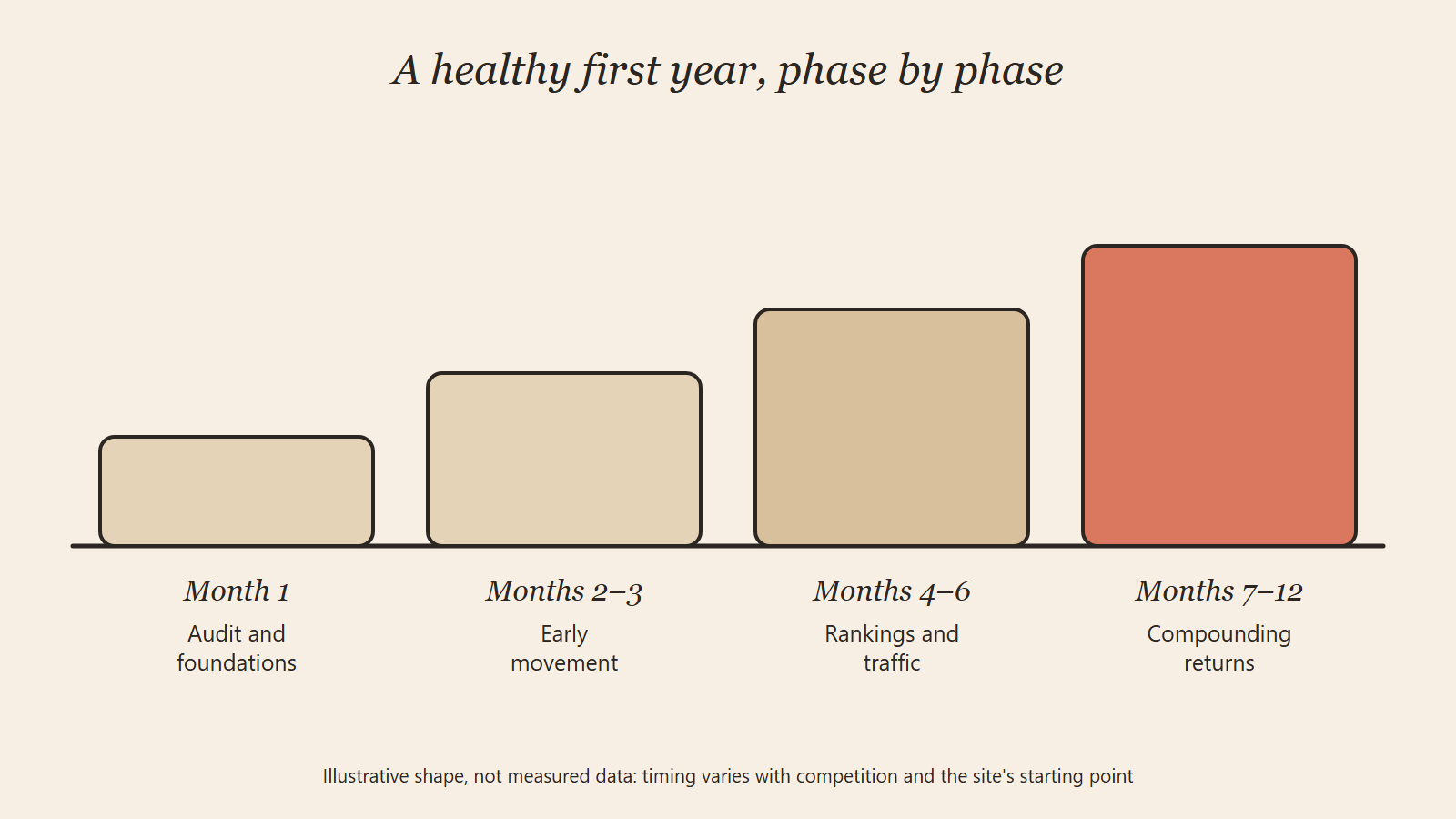
The first month is mostly diagnosis and fixes, months 2 and 3 bring early movement, and months 4 through 12 are where traffic and leads compound. Here is what a healthy year looks like.
Month 1: audit and foundations
A proper audit comes first: crawl errors, indexing gaps, page speed, duplicate pages, and what your competitors rank for that you don't. Technical fixes ship in this window because they unblock everything else. Your Google Search Console and analytics should be set up and tracking correctly before any content is written, or you'll have no clean baseline to measure against.
Months 2 and 3: early movement
Fixed pages get recrawled, and impressions in Search Console usually start rising before clicks do. New pages begin showing up for long, specific searches deep on page two or three. This is also when you'll see the first queries you never targeted, which is a good sign Google is starting to understand what the site is about.
Months 4 to 6: rankings and traffic
Pages that were sitting on page two start breaking onto page one for lower-competition terms. Organic clicks climb, and for local businesses, calls and direction requests from the business profile tend to follow. If nothing has moved by the end of month six, the plan needs a hard review rather than more patience.
Months 7 to 12: compounding returns
Older content keeps gaining as it collects links and engagement, while new content ranks faster because the site now has a track record. This is the stretch where SEO usually starts paying for itself. Work that stops here tends to slide slowly as competitors keep publishing.
Why does SEO take so long?
SEO takes time because Google has to find your changes, test them against other pages, and build confidence that your site deserves to rank. Each of those steps runs on Google's schedule, not yours.
Google has to crawl and index each change
Nothing ranks until Google revisits the page. Google's recrawl documentation states that crawling can take anywhere from a few days to a few weeks. It also notes that asking for a recrawl again and again won't speed it up.
Quality signals need months to confirm
Even after a page is indexed, Google's systems watch how it performs before trusting it. In its core updates guidance, Google says some improvements take effect in days, but it could take several months for its systems to learn and confirm them. Sometimes a recovery waits for the next core update, and those broad updates arrive several times a year.
Older pages hold the top spots
The pages you're trying to beat have had years to collect links and history. Ahrefs' study of how long it takes to rank, updated in May 2025, found the average number one result is five years old and 72.9% of top-10 pages are more than three years old. You're not just improving your own site; you're displacing pages with a long head start.
Links and reputation build at human speed
Other sites link to you when they find something worth citing, and that happens over months. Shortcuts like bought links can get a site penalized, which resets the clock entirely. Our approach is guest posts on relevant, reputable sites, which is slower to arrange but holds its value.
How long does SEO take for a new website?
A new website should plan on 6 to 12 months before organic search becomes a dependable channel, and longer in competitive fields. Early wins are possible, but they come from narrow, low-competition searches rather than your main money keywords.
The data backs this up. Ahrefs' 2025 update found only 1.74% of newly published pages reached the top 10 for any keyword within a year. A new domain is in the hardest version of that position, because every page on it is new and the site has no links pointing in.
What a new site should do first
- Get the technical base right at launch: a clean sitemap, one version of the domain, fast pages, and no accidental "noindex" tags.
- Target long, specific phrases first ("emergency AC repair on weekends" before "AC repair").
- Set up and complete a Google Business Profile on day one if you serve local customers.
- Publish fewer, deeper pages instead of dozens of thin ones.
Building the site with search in mind from the start saves months of cleanup later. Our AI website development work bakes structure, schema, and speed into the build so the clock starts on day one instead of after a fix-up project.
What can move faster than you'd expect?
Technical fixes on an established site and AI answer visibility can both move within weeks. These are the exceptions to the slow-burn rule, and they're where an audit usually finds the quickest return.
Fixing what blocks Google on an existing site
When a site already has history, removing a blocker lets Google reward trust it had already built. Three anonymous examples from our own client work, each comparing the 28 days before our fixes went live with a 28-day window roughly one to three months later:
| Business | What was wrong | Result in that window |
|---|---|---|
| Auto repair shop | Review data showed "0.0 rating" to search engines; 22 thin service pages | Phone calls from Google search 3 to 25; average position 40.3 to 11.4 on the main address |
| Luxury landscaper | 487 guide articles redirected to sales pages | Google AI answer appearances 740 to 3,801; average position 22.9 to 9.8 |
| Tree service | 44 blog posts Google couldn't follow links to | Average position 33.0 to 12.5; clicks from Google up 71% |
None of these sites needed years. They needed someone to find the error that was quietly holding them back.
Showing up in AI answers
Google's AI features documentation says a page must be indexed and eligible to show with a snippet to appear as a link in AI Overviews or AI Mode, with no extra technical requirements. That means AI visibility tends to rise on the same timeline as your regular search visibility,; the landscaper's AI answer appearances rose alongside its rankings. Clear answers near the top of the page, solid schema markup, and pages that answer real questions all help. Our playbook for getting cited in ChatGPT covers the other AI engines.
How do you know SEO is working before rankings arrive?
Watch leading indicators in Google Search Console: indexed pages, impressions, and the number of different queries you appear for should all rise before clicks and leads do. If those are flat after two or three months, something in the plan needs to change.
| Stage | Signal to check | Where to find it | Healthy sign |
|---|---|---|---|
| Weeks 2 to 6 | Pages indexed | Search Console, Pages report | Important pages move from "not indexed" to indexed |
| Months 1 to 3 | Impressions | Search Console, Performance | A rising line, even if clicks are flat |
| Months 2 to 4 | Queries you appear for | Search Console, Queries tab | More, and more specific, search terms each month |
| Months 3 to 6 | Average position on target pages | Search Console, Pages tab | Steady climb toward page one |
| Months 4 to 12 | Calls, forms, sales from organic | Analytics plus call tracking | Leads you can trace to search |
Your monthly report should show these numbers against a fixed starting point, not just a current snapshot. If you want to track AI answers too, our guide to AI search citation tracking shows how to measure what ChatGPT and other assistants say about you.
How do you shorten the SEO timeline without cutting corners?
Fix technical blockers first, aim at keywords you can win this quarter, and publish on a steady schedule. Those three choices cut more time than any trick.
- Start with an audit. The fastest gains hide in errors you didn't know about, like redirects to the wrong page or pages Google can't read.
- Pick winnable keywords. Specific, lower-competition phrases rank first and build the authority that helps your bigger terms later.
- Improve pages that already rank on page two. A page sitting at position 12 is far closer to page one than a page that doesn't exist yet.
- Link your own pages together. Internal links help Google find new pages faster and understand which ones matter most.
- Keep a steady rhythm. Two solid pages a month for a year beats twenty rushed pages in one month and silence after.
What you should avoid matters just as much. Buying links, publishing piles of near-duplicate city pages, or chasing a guarantee of first place can each set a site back by months. Steady, clean work is the shortcut.
Frequently Asked Questions
How long does SEO take to see results for a small business?
Most small businesses see early signals like rising impressions within 1 to 3 months and steady leads within 4 to 6 months. Local businesses with a complete Google Business Profile and low competition often land at the faster end. A new site or a crowded market pushes that out toward a year.
Is Google Ads faster than SEO?
Yes, ads can bring clicks the same day your campaign goes live, while SEO takes months to build. The trade-off is that ad traffic stops the moment you stop paying. Many businesses run ads for quick leads while SEO builds the long-term channel underneath.
Can SEO results disappear after they arrive?
They can fade if the work stops, a competitor outpaces you, or a core update changes how Google judges your pages. Google rolls out broad core updates several times a year, so rankings are never fixed. Regular updates to your best pages are the main defense.
Should I stop SEO if I see nothing after three months?
Not automatically, but you should see leading indicators by then, such as more indexed pages and rising impressions. If those are flat too, ask what was shipped and why it isn't moving. A good provider can show the work and the early data behind it.
How long does it take to show up in Google AI Overviews?
There's no separate clock for AI Overviews. Google says a page must already be indexed and eligible for a snippet, so pages usually start appearing as their normal search visibility grows. Clear, well-structured answers make it easier for AI features to cite you once you're eligible.
Want a Timeline for Your Own Site?
A realistic SEO timeline starts with knowing what's holding your site back today. We'll run a free AI SEO audit that checks indexing, technical errors, your competitors, and how AI search sees your business, then tell you which wins are weeks away and which will take months. You can see how our AI SEO services work, or reach us directly.
WhatsApp our team, email info@speedxmarketing.com, or use our contact page. You'll get a fixed scope and an honest timeline from the team at SpeedX Marketing.