Key takeaways:
- In LocaliQ's 2026 benchmarks, a Google Ads lead costs $66.69 on average, and $131.63 for law firms.
- Paying for Google Ads has no effect on your organic rankings, according to Google itself.
- Ad traffic stops the day your budget stops, while organic rankings usually fade slowly.
- Pew Research found people click a regular result in 8% of visits when an AI summary appears, versus 15% without one.
- Ads now show inside Google's AI Overviews and AI Mode, so both channels are shifting at once.
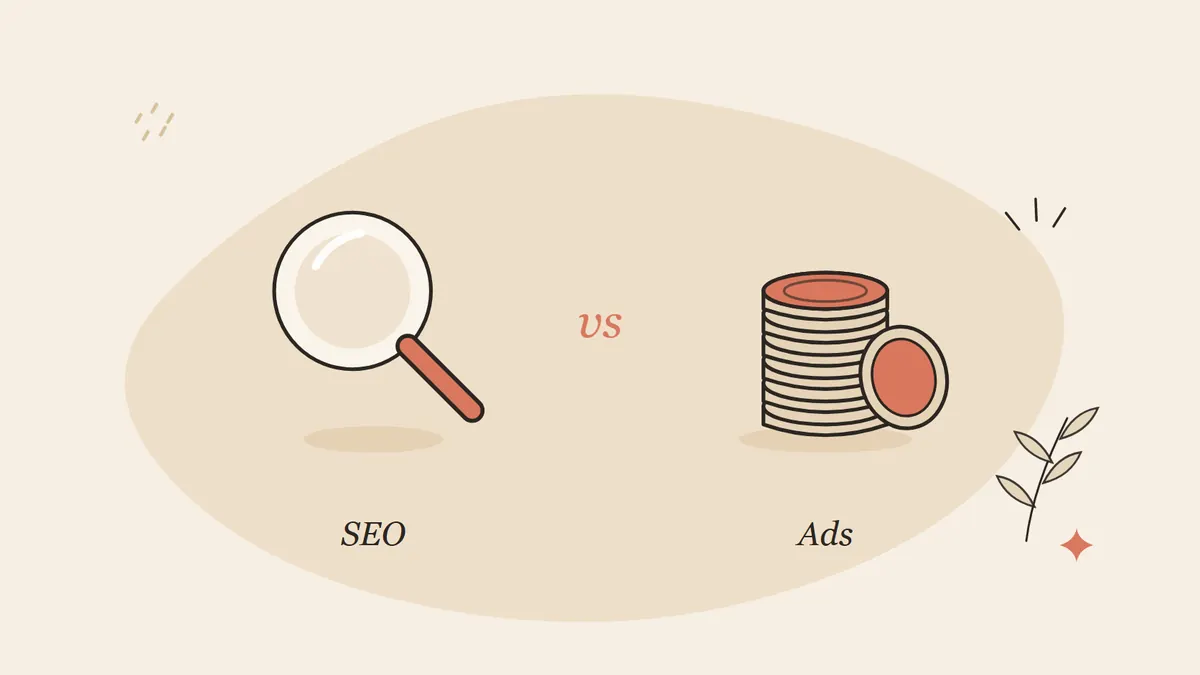
The SEO vs Google Ads question usually comes down to one thing: do you need customers now, or do you need cheaper customers later? Both put you on the same Google results page, but one rents the space and the other earns it. This guide compares them on what actually matters to a small business: cost per lead, speed, what you keep when you stop paying, and how AI answers are changing the page.
One disclosure before we start. SpeedX Marketing runs SEO and AI SEO for small businesses, and we don't manage ad accounts. So we have a side, and we've tried hard to be fair about where ads clearly win.
What is the difference between SEO and Google Ads?
SEO (search engine optimization) is the work of getting your pages into Google's free, organic results. Google Ads is paid search, often called PPC (pay per click): you bid to appear in the "Sponsored" slots and pay each time someone clicks.
The two systems are separate. Google's own guidance on hiring help states that "Advertising with Google won't have any effect on your site's presence in our search results". The same page warns that no one can guarantee a #1 organic ranking. Spending more on ads buys ad placement, nothing else.
| SEO (organic) | Google Ads (paid) | |
|---|---|---|
| How you pay | Your time, or a monthly fee to whoever does the work | Every click, from a budget you set |
| First results | Usually months | Same day the ads are approved |
| When you stop paying | Rankings fade slowly, often over months | Traffic stops right away |
| Who decides your position | Google's ranking systems | Your bid plus ad quality |
| What you own afterwards | Pages, content, reviews, links | Data and lessons, no lasting placement |
| Best for | Steady leads at falling cost | Fast tests, launches, urgent jobs |
| Biggest risk | Waiting months with little to show | High cost per click eating thin margins |
The short version: ads are a tap you can open today and close tomorrow. SEO is closer to digging a well. Slow and uncertain at first, then cheap to draw from.
How much does each one cost a small business?
Google Ads costs whatever your market's clicks cost, multiplied by how many you buy. SEO costs a fairly flat monthly amount, so its cost per lead falls as traffic grows.
What Google Ads clicks and leads cost in 2026
LocaliQ, which runs ad campaigns for thousands of small and mid-sized businesses, publishes yearly averages. Its 2026 search advertising benchmarks put the all-industry average at $5.42 per click and $66.69 per lead. Your local market can sit well above or below these numbers.
| Industry (LocaliQ 2026) | Avg. cost per click | Avg. cost per lead | Leads from $1,500/month (approx.) |
|---|---|---|---|
| Attorneys & legal services | $9.87 | $131.63 | 11 |
| Home & home improvement | $8.33 | $90.92 | 16 |
| Dentists & dental services | $8.00 | $72.97 | 20 |
| Physicians & surgeons | $4.76 | $40.04 | 37 |
| Automotive repair, service & parts | $4.35 | $29.96 | 50 |
| Restaurants & food | $2.05 | $30.57 | 49 |
| All industries | $5.42 | $66.69 | 22 |
Read the last column carefully. A home improvement company spending $1,500 a month buys roughly 180 clicks and about 16 leads at average rates. Next month it pays the same again for the next 16.
Budgets also flex day to day. Google Ads Help explains that for most campaigns a single day can spend up to two times your average daily budget, while the month is capped at 30.4 times that daily figure. Plan cash flow around the monthly number, not the daily one.
What SEO costs
SEO pricing is less standard, so treat any figure as a range. In an Ahrefs survey of 439 SEO providers, the most common monthly retainer was $501 to $1,000 (20.4% of respondents), and 42.8% charged between $501 and $2,000 a month. Scope drives the number: how many pages need fixing, how competitive your searches are, and how much content you need.
The key difference is what happens to cost per lead over time. In month two, SEO may bring zero leads, which makes it the most expensive channel you own. By month twelve, the same fee might sit behind dozens of leads a month that you are not paying per click for.
How fast does each one bring in customers?
Google Ads can put you in front of searchers the day your ads are approved. SEO usually takes months, because Google has to crawl your changes, test where they fit, and see other sites vouch for you.
Google doesn't publish a standard SEO timeline. Instead, its guidance tells business owners to ask any provider what results to expect "and in what timeframe," which is a fair test of whether someone is being straight with you. A site with years of history and a few fixable problems can move within weeks. A brand-new domain in a crowded field can take a year.
Speed matters most when the cost of waiting is high. If an empty appointment book next month means missing payroll, ads are the honest answer. If you can absorb a slow quarter, SEO compounds while ads only repeat.
When should a small business start with Google Ads?
Start with ads when you need demand you can switch on, or when you need answers fast. Five situations where we would tell you to run ads first:
- Your site is brand new. It has no history, so organic results are months away no matter what you do.
- The job is urgent. Burst pipes, locked-out drivers, and broken AC get booked from whoever shows up at the top today.
- You're testing an offer. Ads tell you within weeks which services and searches actually produce calls.
- It's seasonal or time-limited. A spring promotion or a holiday menu has no time to wait for rankings.
- Your cost per lead is low. In fields like auto repair, a $30 lead against a several-hundred-dollar job is easy math.
Local Services Ads: the pay-per-lead option
If you run a home service, legal, or similar local business, look at Google's Local Services Ads before standard search ads. Google's Local Services help page says you "only pay when a customer gets in touch from your ad," through calls, messages, or bookings. Paying per contact instead of per click removes some of the waste from people who click and leave.
Whichever ad type you use, answer the phone. A paid lead that rings out costs you the full price and returns nothing. That gap is one reason some businesses add an AI calling agent to catch after-hours calls.
When should SEO come first?
Lead with SEO when your clicks are expensive, your buyers research before they call, or you can plan more than six months ahead. These are the cases where paying per click works against you:
- High cost per lead. At $131.63 per legal lead, a firm spending $3,000 a month gets about 23 leads. Organic leads carry no per-click charge, so the gap widens every month you rank.
- Buyers ask questions first. People compare dental implants or kitchen remodels for weeks. Helpful pages catch them at every step; ads mostly catch the final search.
- You want an asset. A page ranking for "how much does a roof inspection cost" keeps working after the invoice is paid.
- You want to show up in AI answers. ChatGPT, Perplexity, and Google's AI features draw on pages that are crawlable, specific, and trusted. That's SEO work, and you can't buy a citation.
In our experience, the businesses that regret SEO are the ones that started it with three months of cash and needed results in two. If that's you, run ads first and start SEO once revenue is steady.
How has AI search changed the SEO vs PPC math?
AI summaries now sit above both ads and organic links on many searches, and they take clicks from both. Organic results that get cited inside those answers keep some visibility, while ads are being moved into the answers too.
Fewer clicks when an AI summary appears
Pew Research Center tracked the browsing of 900 US adults in March 2025. When a Google AI summary appeared, people clicked a traditional result in 8% of visits, against 15% when there was no summary. They clicked a link inside the summary itself in just 1% of visits.
That doesn't make SEO pointless. It changes the goal from "rank and get the click" to "be the source the answer is built from," and to measure being named, not only being clicked. Our guide on tracking AI search citations covers how to see what ChatGPT and others say about you.
Ads are moving into AI answers
Paid search is changing too. As TechCrunch reported from Google Marketing Live in May 2025, Google began testing Search and Shopping ads inside AI Mode and announced ads in AI Overviews on US desktop. Those ads come from existing Search, Shopping, and Performance Max campaigns, so there's no separate "AI slot" a small advertiser can simply buy.
So neither channel is a safe pair of hands on its own. The practical response is to make your pages easy for AI to quote, with clear answers, real numbers, and schema markup AI engines read, while keeping ads for the searches where you need a guaranteed spot.
Should you run both, and how do you split the budget?
For most small businesses, yes: run both, but not at equal weight forever. Ads carry the load early, and SEO takes over as rankings arrive.
| Your situation | Ads share | SEO share | Why |
|---|---|---|---|
| New site, need leads in 60 days | 70 to 80% | 20 to 30% | Ads pay the bills while basic SEO gets the site found |
| Established site, cheap clicks (under $3) | 40 to 50% | 50 to 60% | Ads are efficient, so keep them while SEO grows |
| Established site, expensive clicks ($8 or more) | 20 to 30% | 70 to 80% | Each organic lead saves a large per-lead fee |
| Ranking well already, flat growth | 10 to 20% | 80 to 90% | Ads only for gaps and promotions |
| Seasonal business | Peaks only | Year-round | Rankings must be in place before the season starts |
These splits are starting points from our own planning, not industry rules. Adjust them as your numbers come in.
How the two channels help each other
- Use ad data to pick SEO topics. Your search terms report shows which exact searches turn into calls. Write pages for those first.
- Lower bids where you already rank. Once you hold a strong organic spot for a term, test cutting its ad spend and watch whether total leads hold.
- Keep ads on terms you can't rank for yet. Competitive "near me" searches can take a long time to win organically.
We've seen the shift work in practice. A solar installer came to us with 41% of its site visits coming from paid ads after a site rebuild had hidden much of its content from Google. After we fixed the technical problems and rebuilt lost pages, leads from Google search rose from 4 to 12 when comparing the 28 days before our launch with a later 28-day window.
How do you tell which one is paying off?
Compare both channels on cost per lead and, where you can, cost per customer. Clicks and rankings are useful signals, but a channel only pays off when it books work.
- Google Ads: the platform reports cost per conversion, as long as conversion tracking (calls, forms, bookings) is set up correctly.
- SEO: divide your monthly SEO cost by organic leads, using Google Search Console for search data and analytics or call tracking for leads.
- AI visibility: check whether AI assistants mention or cite you for your main services, and watch for visits from tools like ChatGPT in your analytics.
Give SEO a fair window before judging it; month two numbers say little. For ads, a month of clean tracking is usually enough to see whether a campaign earns its keep.
Frequently Asked Questions
Is SEO cheaper than Google Ads?
Over a year or more, SEO usually costs less per lead because you aren't paying for each click. In the first few months it often costs more per lead, since you pay before results arrive. Ads are cheaper only while you need speed or your clicks are inexpensive.
Does running Google Ads help my SEO rankings?
No. Google states that advertising has no effect on a site's presence in its organic results. Ads can still help indirectly by showing you which searches convert, so you know which pages to build.
Can I stop Google Ads once SEO starts working?
Often you can cut ads back sharply, but test it rather than switching off overnight. Reduce spend on terms where you rank in the top few results, watch total leads for a few weeks, and keep ads on searches you still don't rank for.
Is PPC the same as Google Ads?
PPC is the pricing model, and Google Ads is the biggest platform that uses it. Microsoft Advertising and most social ad platforms also charge per click. In small business conversations, "PPC" usually means Google search ads.
How much should a small business spend on Google Ads?
Work back from your cost per lead. If leads in your field average around $70 and you want 20 a month, plan for roughly $1,400 plus a margin for testing. A budget too small to buy a handful of leads won't teach you anything.
Not sure which channel fits your business?
Start with a free AI SEO audit. We'll check how your site shows up in Google and in AI answers, where your organic chances are strongest, and which searches are probably worth paying for while SEO builds. You'll get a clear answer on what to fix first, and if you want our help with the SEO side, a fixed-scope quote afterwards.
Reach us on WhatsApp our team, email info@speedxmarketing.com, or use the contact page. Talk soon, from the team at SpeedX Marketing.